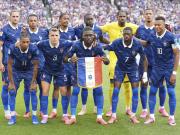
There are many internet memes about French football, such as "bashing France," "surrendering," and "internal strife," but the most frequently mentioned is "Gallic Uzbekistan." The gist is that French football's current strength stems from naturalizing a bunch of African players, taking a shortcut.
Former Spanish Prime Minister Rajoy even made outrageous remarks before the match, saying that "there is not a single Frenchman on the French team."
But the truth is, French football hardly needs naturalized players; they rely on native-born French players. In fact, because their own football industry is so developed, it has benefited many of their poorer African neighbors. The rise of football in a significant portion of African countries today is thanks to France.

Are the black players in France naturalized?
Baidu Baike defines "naturalized players" as players who voluntarily and actively acquire citizenship in a country other than their birth country, falling under the category of skilled migration. The core indicator for naturalization is "birth country."
Furthermore, when describing someone's feelings for their hometown, we often use the phrase "born and raised in one place." This means someone was born and raised in a particular place, describing them as a true local. This encompasses two relatively universal rules of nationality identification internationally: " born" is based on the principle of "territoriality," meaning that being born in a place justifies acquiring its nationality. " raised in one's native land" is based on the principle of "cultural identity," referring to growing up in a country, being deeply influenced by its culture, and thus being a true local.
Looking at France's 26-man squad for the USA-Mexico World Cup, 23 of them were born in France and trained in the French youth system. These are all "homegrown" Frenchmen. There are three exceptions:
Marcus Thuram, Bryce Samba, and Michael Orise. Marcus Thuram was born in Parma, Italy, because his father, Lilian Thuram, worked there at the time. Both his parents were French, even honored members of the French clergy. He is undoubtedly French.
Blaise Samba was born in Rinzolo, Congo, and immigrated to France with his parents when he was young. He received youth training in Le Havre, France, and is a native Frenchman.
Michael Olise was born in London, England, and received youth training at clubs such as Arsenal, Chelsea, and Reading, making him a true "native-born" Englishman. His father even holds British citizenship, and he plays for the French national team solely based on his mother's Algerian/French dual citizenship. This can be considered naturalization in the conventional sense.
Looking at the French 26-man squad, only Orise is truly a naturalized player. If anyone questions whether this French team relies on naturalization, it's truly unfair.

The universal concept of citizenship established by the French Revolution
The blue, white, and red cap badges worn by Parisian citizens during the revolution in July 1789 gave rise to the French tricolor flag. These three colors represent "liberty," "equality," and "fraternity," becoming the cornerstone of the French Revolution's ideology and universal values that have influenced the world ever since. This also laid the foundation for France's acceptance of Black communities.
Since the French overthrew the rule of their own aristocracy with the revolutionary idea of "equality," they could not avoid the logical flaw of class differences between blacks in the colonies and whites in the native lands. Therefore, after the French Revolution, the abolition of slavery and the granting of basic human rights to blacks in the colonies became a natural consequence.
Since "freedom" was being promoted, the Black community could not be confined to tribes or plantations; they naturally had the right to freely migrate to France.
Since they claim to be "benevolent" and that all people are brothers, then their practice of racial segregation and discrimination against Black people seems utterly untenable.
The Declaration of the Rights of Man and of the Citizen, promulgated in 1789, had a profound influence on shaping the French concept of universal citizenship. It established the principle of equality before the law for all, regardless of race or origin. French citizenship was defined as "loyalty to the Republic and residence in French territory," unrelated to whether one was white or black.
Bound by the spirit of the Universal Declaration of Human Rights, French law still prohibits the government from statistically analyzing the race and color of its citizens. At the national level, it does not recognize classifications such as "Black, Arab, or White," but only the unified concept of "French citizenship." The underlying logic is that citizenship is uniform and universal; artificially dividing citizens according to skin color violates the principle of equality before the law. (This is vastly different from their arch-rival, Britain—the British explicitly acknowledge racial differences, and their later policy of divide and rule based on racial distinctions stemmed from this.)
The historical ties between France and Black people
Let's briefly review some important historical periods:
France has two main political divisions overseas: colonies and overseas departments. Colonies are areas with indigenous populations, such as West Africa, where France only has control and they are not considered natural national territory; these are called "colonies." There are also uninhabited islands in the Caribbean, such as Martinique and Guadeloupe, which can be directly incorporated into French territory and are called "overseas departments."
In addition to plundering resources in its colonies, France also established French-language public schools to instill French culture and implement assimilation education for easier governance. The Black indigenous people who underwent these cultural transformations were, according to the principle of "cultural identity," already considered "French." These people were fundamentally different from the "uncivilized" indigenous people of the colonies who remained hidden in the deep forests, still living a life of gathering and hunting.
Those Black people transported to Caribbean plantations by the slave trade naturally acquired French citizenship based on the principle of "territoriality" because they lived in French overseas territories.
These two groups were the first Black people to become French citizens, but their overall size was very small. What truly opened the French society to Black people were the three significant historical contributions made to France by Black people in the 20th century:
During World War I, France suffered heavy casualties among its young and able-bodied men, resulting in a severe manpower shortage. The French government conscripted hundreds of thousands of Black soldiers from its West African colonies to fight in Europe, making a significant contribution to France's victory. After the war, to honor these African soldiers, the French government passed legislation granting them full citizenship rights and allowing them to settle in France with their families, thus establishing the first large-scale Black settlement communities in France.
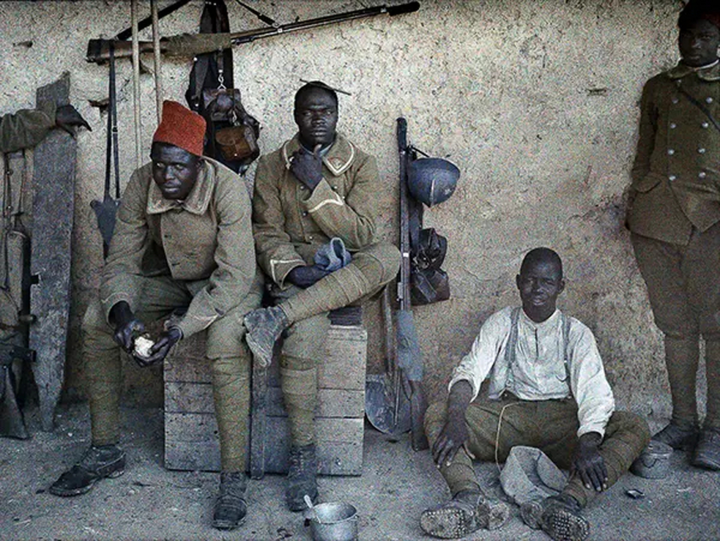
In 1940, after France fell to the Japanese during World War II, Charles de Gaulle went into exile in London and rebuilt his army using soldiers from French African colonies. Of the 400,000 Free French soldiers, over 300,000 were Black Africans. These Black soldiers also participated in the later battles to liberate France and Germany. After the war, they and their families all obtained French citizenship, forming the second wave of Black immigration to France.
Following World War II, with the implementation of the Marshall Plan, Europe entered a period of reconstruction. Due to the population casualties caused by the two world wars, and the unwillingness of native white people to engage in heavy manual labor such as mining, infrastructure, sanitation, and factories, a huge labor shortage emerged during industrial expansion. France once again turned its attention to its Black brothers—beginning the targeted importation of African laborers. Large numbers of Black people flooded into France, and Black immigration began to grow exponentially. In 2011, an Oscar-nominated French film, *The Intouchables*, told the story of how traditionally white French society, initially harboring reservations about Black laborers, eventually embraced them warmly, reflecting the cross-racial social integration of Black and White communities in France.
The vast majority of players currently playing for the French national team have ancestors who immigrated through these routes. Their ancestors made historical contributions to France; they were born in France, immersed in French culture, and enjoyed the same national benefits as French citizens, including education, healthcare, and pensions. They benefited from the French football youth training system and grew into professional players. If these players had been born in Africa, their professional achievements would be highly questionable. It is the French social system that has made them who they are today, a testament to France's national strength. They are certainly qualified to represent France in international competitions and showcase the country's image. They identify with their French identity and are proud to represent France. This is fundamentally different from countries like Cape Verde and Morocco, which lack the capacity to cultivate their own talent and rely on distant kinship ties to find a bunch of opportunistic naturalized players who "don't understand their own culture and are settling for second best because they can't be selected for their home countries' national teams."
They are genuine, native-born French people.
African countries' naturalization of French players
Currently, France has a population of 68 million, with 2.2 million registered players and over 30,000 free football fields nationwide, meaning almost every village and town has a club. A four-tiered pyramid youth training system has been established, from the grassroots community level, through the mid-level regional levels, to the top-level Clairefontaine National Football Academy, and finally to professional club youth training, providing a comprehensive development path for players aged 6 to 19.
According to the latest data released by CIES (International Centre for Sport Studies) in 2026, France's youth training system has produced as many as 540 players currently playing in Europe's top five leagues. This puts France far ahead of other countries globally in terms of the scale of its youth training output, surpassing Brazil, Argentina, and the Netherlands. Prior to this World Cup, The Times compiled a list of the birthplaces of 1,248 players from 48 teams, revealing 99 born in France, again significantly ahead of the Netherlands' 67 and England's 49.
Because France's youth academy is so powerful that its national team has more players than it can use, resulting in a huge surplus of human resources. Historically, France has repeatedly exploited this talent pool, and today, for the first time, African nations are turning their attention to their "big brother," finally achieving a breakthrough. Aside from 23 players who play for the French national team, the remaining 76 are all affiliated with their African neighbors. These include 13 from Algeria, 11 from the Democratic Republic of Congo, 10 from Senegal, and 7-9 each from Morocco and Ivory Coast. Crucially, these players eliminated by France are quite strong, as all of these teams advanced to the knockout stages.
Football associations from these countries have established offices in Paris, meticulously tracing player origins and establishing connections from the time they were children, continuously monitoring their progress. They've implemented dual citizenship policies to facilitate player naturalization. Especially before major tournaments like the Africa Cup of Nations and the World Cup, they lure players with the promise of participation, conducting mass naturalization efforts. For example, Inter Milan's Bony switched to Ivory Coast in the first half of 2026 due to the allure of the World Cup. Even more famous is the case of Luca Zidane, whose shaking of his head in dismay at Algeria's 0-3 loss to Argentina during the match was a memorable moment.
Even more absurd is Comoros, who have completely given up. Almost all of their players were born and trained in France, relying entirely on French players in competitions. They have absolutely no desire to put in any effort.

According to academic estimates, Black people now make up about 10% of the total population of France. Including North African whites, people of African descent comprise about 15%-20%. Their inherent athleticism and economic class (the poorer populations are more willing to change their fate through football) have created a huge goldmine for French football. Combined with the highly efficient refinement process of the French youth training system, it's a truly powerful combination. Together, they have contributed to the current talent boom in French football, and these cultivated talents are not only used for domestic selection but also exported globally. This is the true strength of French football.