The controversy surrounding the red card sent off American player Balogun continues to escalate. Following intervention from US President Trump, FIFA's Disciplinary Committee made the unusual decision to suspend his ban. This decision has not only raised questions about the ruling process but has also sparked widespread discussion both on and off the World Cup stage.
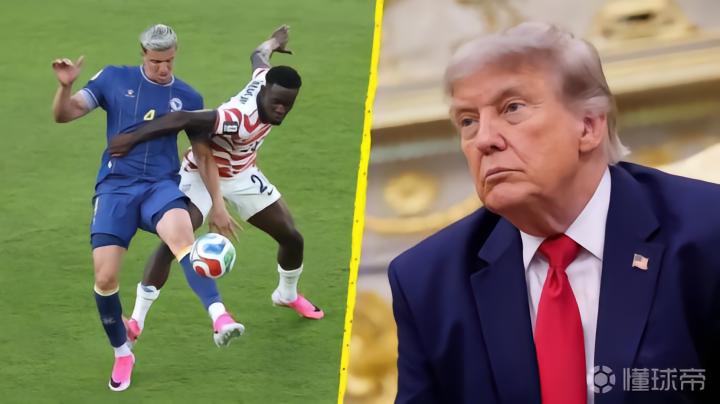
According to British media outlet talkSPORT, Balogun was sent off with a red card in the World Cup Round of 32 match between the United States and Bosnia and Herzegovina. Subsequently, US President Trump requested a review of the decision from FIFA President Gianni Infantino and publicly admitted to interfering. Ultimately, the FIFA Disciplinary Committee decided to impose a suspended ban on Balogun, allowing him to play in the subsequent match in which the United States lost 1-4 to Belgium.
The report states that the ruling was made solely by FIFA Disciplinary Committee President Mohamed Al-Kamali. While it is not uncommon for disciplinary cases to be handled by a single arbitrator, they are usually handled by other members or Vice President Jorge Palacio, and significant cases involving precedents are generally handled by a three-person panel. Therefore, this ruling by the president alone is considered extremely rare procedurally.
FIFA emphasized that the decision was made independently, free from external influence. However, after Trump's involvement was revealed and confirmed by him, doubts about the fairness of FIFA's ruling intensified. The controversy deepened further because other players who received red cards at this World Cup were immediately suspended. For example, England defender Cuaanza, after being sent off in the match against Mexico, was suspended for two matches, missing his team's quarter-final victory against Norway and also missing the semi-final against Argentina.
The US Soccer Federation argued in its appeal that the refereeing team relied too heavily on slow-motion replays and static footage, leading to a biased judgment regarding Balogun's foul. However, talkSPORT pointed out that VAR used similar technology during Cua Anza's sent-off, but the English FA was unable to appeal that. According to the schedule, Cua Anza's suspension will be completed after the semi-final. If England advances to the final, he will have a chance to return; if they fail to advance, he can participate in the third-place match. Currently, the controversy surrounding the Balogun incident continues to escalate, and the fairness of FIFA's ruling procedures will continue to be a focus of attention.