On July 13, after returning to China from officiating at the World Cup, Chinese referee Fu Ming was interviewed by CCTV and talked with host Zeng Kan about his experience officiating at the World Cup.
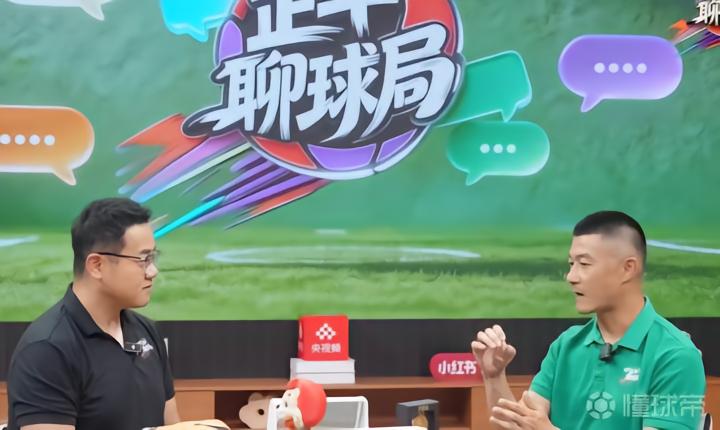
We've arrived at the International Broadcast Center to officiate this match. What's the general workflow?
We are actually similar to referees. We also need to study the teams and the players. We need to constantly review different teams and different battles to form muscle memory. Then, when you are reviewing, you will be faster and more direct.
So how long does this preparation process usually take?
We have a team behind us that creates a separate PowerPoint presentation for each of the World Cup teams. These presentations cover topics like set pieces, their tactics and strategies, how they defend and attack from set pieces, their dynamics during transitions between attack and defense, what happens, key players, and common fouls. This is a huge support system provided by FIFA.
You see, many fans are even more curious about the Video Assistant Referee (VAR) or Assistant VAR. For example, some fans have wondered why there weren't any seats for this particular starting lineup.
Frankly speaking, there's no inherent hierarchy of importance. VAR, AVAR, and supportVAR work in harmony. For example, when VAR is reviewing a case, if they're overly focused on the event itself, under pressure, and dealing with a crucial decision, they might forget some procedures. The person behind them will constantly remind them when they miss something, ensuring the rigor of the review. Therefore, the challenge and pressure on referees during the World Cup are truly World Cup-level, which is why I believe such a team is essential.
So, where does the video assistant referee (VAR) face his biggest challenge?
This actually stems from regular training. When you need to select a camera position, you already have a spatial awareness in your mind. Immediately, your mind will think of either the goal line camera or the behind-the-goal camera. At this point, your spatial awareness will come into play. This is actually muscle memory.
Can I imagine this scenario now? Actually, during the game, the video assistant referee booth is a space where everyone is constantly talking and exchanging ideas. It's a highly tense space with an extremely high information density.
Actually, it's a bit different from what you might imagine. At this level of VAR, the decision to make a ruling or judgment requires evidence and keywords. If a link in the chain is missing, the person behind it provides a keyword, and the VAR immediately realizes what needs to be done. So, in fact, in high-level competition, it's often just a brief reminder that completes the process.
For example, if I'm VAR now, and I'm watching the whole process of a penalty kick, how would you alert me?
While you were adjusting the camera angle, I knew that you were basically saying things like, "For me, this is the penalty," and that you were making the decision simultaneously with the referee. You weren't just watching the referee's decision; you were making the decision together with him. The person standing behind you was actually thinking the same thing. What would he say to him? "OK, check the app," because that's a phrase used to describe the attack initiation phase, where you need to check if there was offside before the penalty kick.
So, looking at it this way, fans don't need to worry at all. The current World Cup matches, at least at this stage, are as close to 100% fair as possible. Fu Ming: 100% . Why can we make such a conclusion?
The World Cup is a dream for all referees, a dream they've pursued for many years, and it's incredibly difficult to achieve; everyone cherishes it. In fact, this is even more true when making crucial refereeing decisions. When the pressure comes, everyone must muster the courage to make the decision. This is essential, and it's a skill we've honed through years of training.
Then you won't think, "I need to explain the correct rules, or how the judgment should be made, but I encounter a lot of misunderstandings, and I want to popularize the rules to everyone?"
The matches I need to serve include the players, coaches, spectators, and everyone else, because everyone has their own side to support. You can't expect everyone to be satisfied with the decision; that's impossible. What you can do is make relatively fair decisions based on the rules of football, the spirit of the rules of football, and the VAR protocol. Everything it provides is my standard of judgment. So, as I just told you, I won't overthink that issue.
You said this gold medal is the result of 20 years of hard work. To be honest, how long did you work hard for this World Cup? What was that period like? And in terms of your career, how long have you been working hard for it?
We started preparing for this World Cup after the 2022 World Cup ended. As for the World Cup dream, it began when you started becoming a referee.
What year was that?
In 2004, I just started working as a referee and knew about the World Cup, where referees officiated. Of course, I had been watching the World Cup for a long time, but I never paid attention to the referees when I was watching it. So when I actually started working as a referee, I thought about it, but it seemed like a distant dream.
So what kind of effort does it take to achieve this?
I think it's very important to have goals and dreams, but also to take things one step at a time and do the work at hand in a down-to-earth manner. First and foremost, you have to be down-to-earth and do things one step at a time; otherwise, you can't expect to achieve great things overnight.
Including this arduous physical training, how should physical training be conducted?
Our physical fitness is now very comprehensive. High-intensity training includes exhaustion tests and yo-yo tests. These tests have no limits; they don't set any limits for you. You just run until you can't run anymore, until your heart rate reaches a point where you can't go any further. In fact, it's not just these tests; there are also agility tests. It combines training with testing.
Because World Cup referees also need physical fitness, especially top-level referees, they need things like core strength, muscle strength, and, as I mentioned earlier, agility, coordination, and flexibility. Agility, coordination, and flexibility are crucial for preventing injuries. Within this broader framework of physical fitness, we're taught how to eat, how to sleep, how to train, how to prevent injuries, and how to cope with injuries—these are all challenges we face. So when you talk about physical fitness, a whole host of terms come to mind. These are my thoughts on physical fitness.
So, in fact, every one of you running on the World Cup field is a veteran. In a sense, you see, even this jersey, which has been in front of me for so long, but when I looked at it carefully, I found that there was something different about it.
We wear the same referee uniform.
So what do you usually put in your pocket when you're enforcing the law?
Red and yellow cards, that's my habit. (Right) Yellow card, (Left) Red card. I'm right-handed, so I tend to use my right hand more often. You don't seem to use your right hand more often, so it's easier for me to draw yellow cards.
If one day, when you retire, Fu Ming were to evaluate referee Fu Ming, what kind of referee do you think he is?
Wow, that's a good question. Before working with VAR, I felt my understanding of referees wasn't comprehensive enough. After working with VAR for so long, I think I've actually changed. On the field, I can now focus on controlling my emotions, because VAR requires emotional control during the work process. Emotions can affect your rulings and judgments, and they can also cause anxiety and tension. Calmness and composure bring more efficiency, procedural fairness, and impartial decision-making. So, through working with VAR, I've been reflecting on the fact that you're a fair machine, but you're also human; you have warmth, you can empathize with the players, and you can empathize with the entire field. This is the balance we strive for.
So what we see is referee Fu Ming, who is a robot who retains a very good human touch and makes extremely accurate judgments.
This is the direction I will strive towards.