Special Contributor | Yan Zimeng
Tania turned off the live stream; she didn't want to watch the opening ceremony anymore.
That day, she was at home in Mexico City working on a marketing report. To accommodate the need for crowd control during the World Cup, the company had employees work from home.
At 11:30, the opening ceremony began, and she turned on the live stream on her computer. The opening ceremony blended Aztec culture with football, with Mexican musician Lila Downs reciting in alternating Spanish and English: "Mexico is an inclusive country," and "Football unites us."
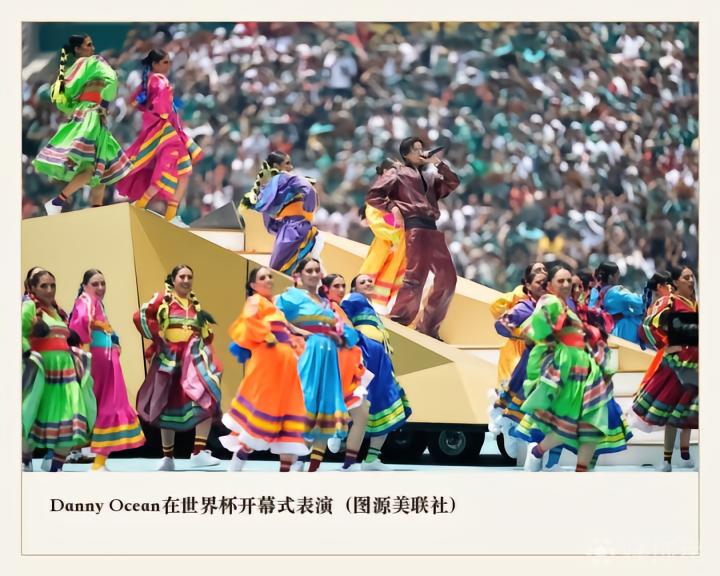
The award-winning local rock band Maná then took the stage, and the audience cheered "Mexico!" repeatedly, led by the lead singer. Indigenous dancers wearing feather headdresses swayed to the rhythm below a rising platform. Next, Venezuelan pop singer Danny Ocean appeared, sporting slicked-back hair and sunglasses. His backup dancers, dressed in traditional Mexican dresses, twirled their skirts and performed classic dance moves.
Dania was very dissatisfied: the Aztec rituals were fleeting, the dancers with feathered headdresses were merely backup dancers, and the folk costumes became a backdrop for Venezuelan singers. "Every state in Mexico has its own representative dances, and I don't understand why they weren't included." Culture was secondary; the stars were the main characters, and few of the stars were Mexican.
When Shakira, the headliner, started her performance, she turned off the live stream amidst cheers from the audience.
Dania is 25 years old and comes from Mexico City. Amidst the intense football atmosphere of the past month, she chose to avoid the World Cup.
"It wasn't that I hadn't considered joining in at first."
Two days after the opening ceremony, Mexico City hosted a World Cup celebration parade themed "Football Comes Home." Starting at the Diana Hunters Fountain, the parade proceeded along Reforma Boulevard and ended at the Revolution Monument, where thousands had already gathered.
The march, scheduled to begin at 1 p.m., was delayed. Twenty minutes later, Mexico City Mayor Brugada arrived late, surrounded by boos. Dana, waiting at the Reforma 222 shopping mall on the other side of the road, was equally resentful: "I couldn't see Brugada from where I was standing, thank goodness I didn't see her."

The parade began as scheduled. Leading the procession were fifty dancers dressed as indigenous people, performing a show inspired by ancient Mesoamerican football rituals. Behind them, floats displayed Day of the Dead altars erected for deceased football stars like Pelé and Maradona, their portraits surrounded by marigolds and skulls. Following them were giant balloons of the mascots from past FIFA World Cups in Mexico, and colorful alebrije figures shaped like newts and hummingbirds. More than 1,400 performers marched along Reforma Avenue for three kilometers.
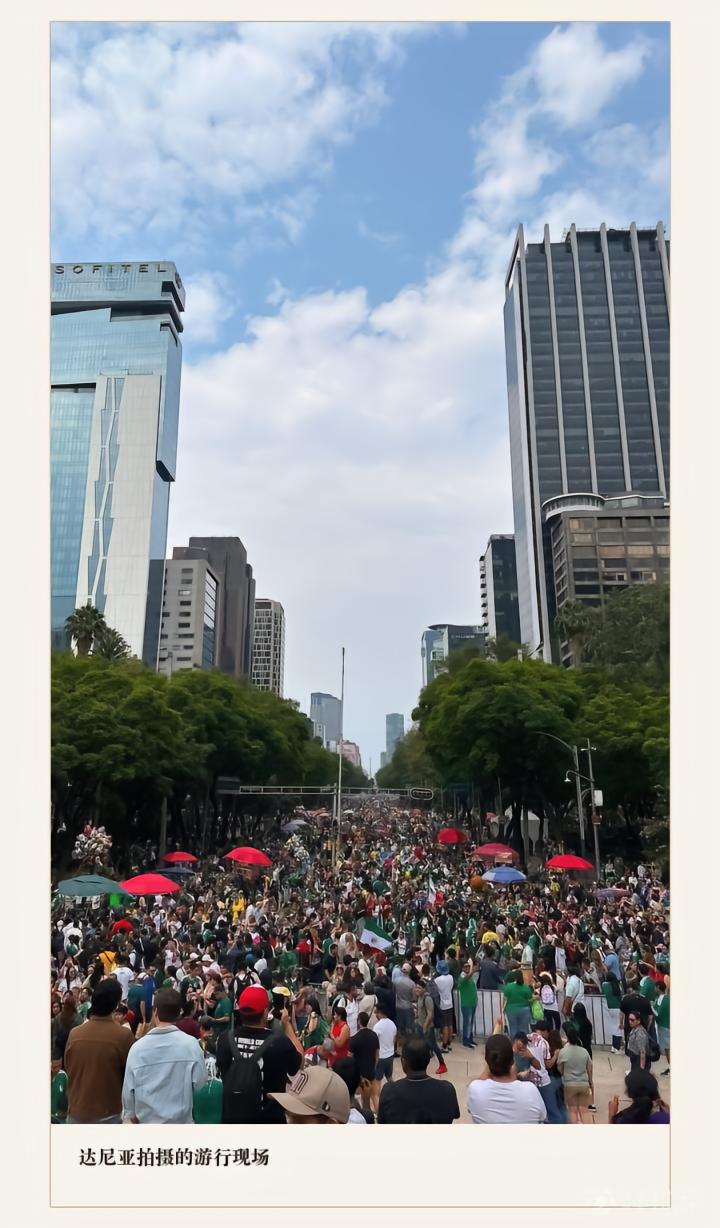
The crowd was so dense that Dania and her friend could only see the tops of the floats even when they stood on tiptoe. Her friend suggested going to the nearby Angel of Independence Monument. The monument's base had a ring of steps raised above the ground; standing on them, one could see across the crowd to the entire Reformation Avenue.
The Angel of Independence Monument is a landmark of Mexico City, built in 1910 to commemorate the 100th anniversary of the independence movement. The 6.7-meter-tall bronze angel statue witnessed the jubilation during Mexico's last hosting of the World Cup in 1986—the celebration crowds damaged the monument, and restoration took months; it also witnessed the massive protests against the killing of women in 2019—the base was spray-painted with 565 slogans, one of which, after restoration, was agreed by officials and protesters to be permanently preserved: "Live, I want you to live."
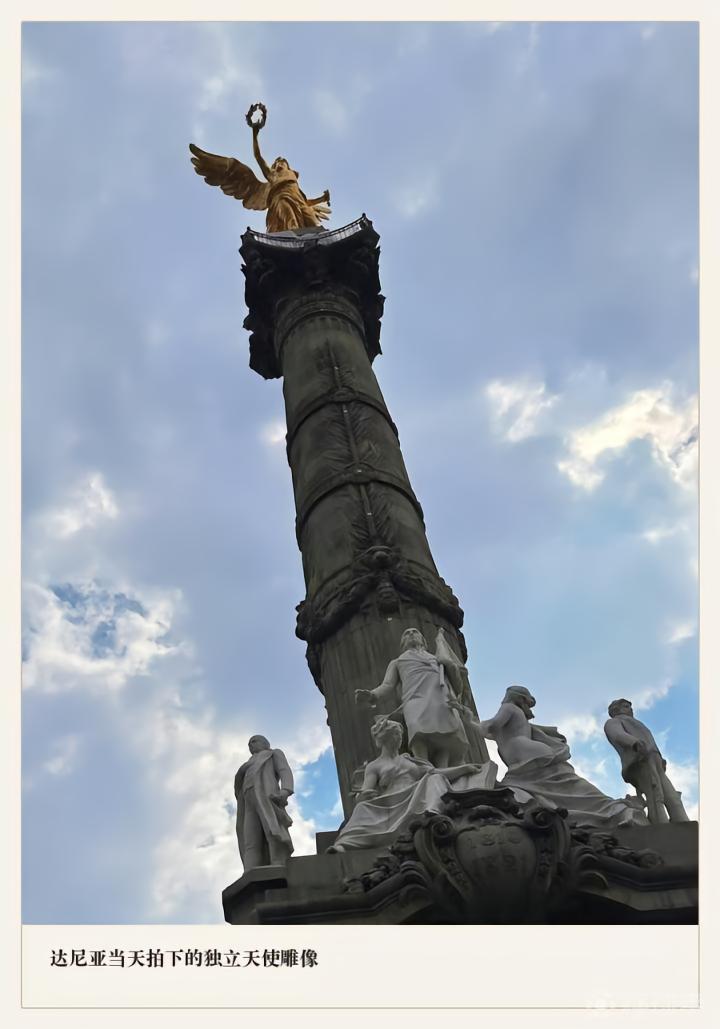
Dania and her friend walked up the steps, hoping to find a spot with a clear view of the parade. Before they even found a spot, their view was blocked by the base: posters were plastered all around the angel statue, one after another. Young faces were printed on them, with the words "DESAPARECIDA/O" in bold black above the photos, and the names, dates of disappearance, and locations below.
Behind her, the marching drums continued, and colorful balloons floated overhead. Dania didn't look for another spot. Below the steps, a woman was arranging the posters; her T-shirt bore a picture of her daughter and information about her missing.
In 2025, an average of 40 people disappeared every day in Mexico. Criminal groups, needing manpower to expand, primarily targeted young people. Some were lured in with promises of money, while others were forcibly abducted. Those who disobeyed or lost their usefulness were killed and buried in secret graves. Government incompetence fueled rampant crime, and the number of missing persons continued to rise. Mass graves were constantly being dug across the country, unearthing unrecognizable bodies. As of 2025, over 130,000 missing persons cases had been registered.
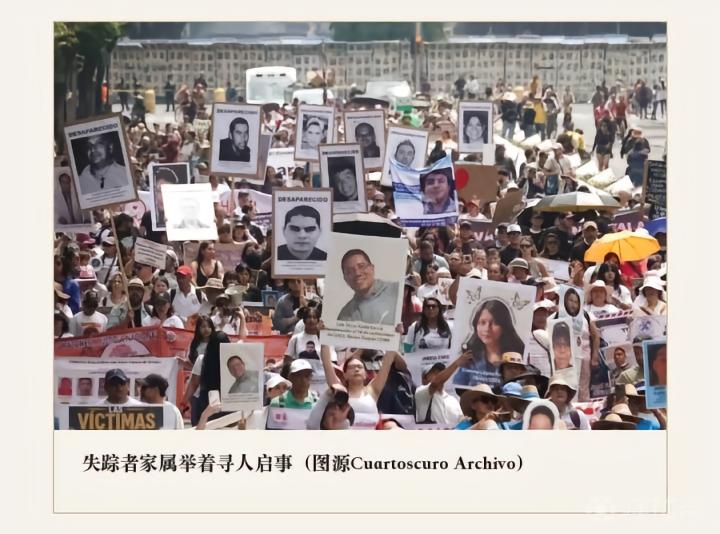
Those searching for missing persons have also become targets of criminal organizations. Families of missing persons have spontaneously formed search groups, some of whose founders have received threatening letters from criminal gangs, some have been taken from their homes by unknown armed men, and others have had their bodies found in their homes with multiple stab wounds.
Officials established a 1.6-kilometer radius control zone around the stadium, named "The Last Mile" (última milla). Checkpoints were set up along the route to manage pedestrian and vehicular traffic. Only four types of people were allowed to enter the control zone: fans with day tickets, local residents showing identification, FIFA-certified staff, and government personnel responsible for security. For tourists, it was the last stretch of road before reaching the stadium; for residents, it was a checkpoint on their way home where they were required to show identification.
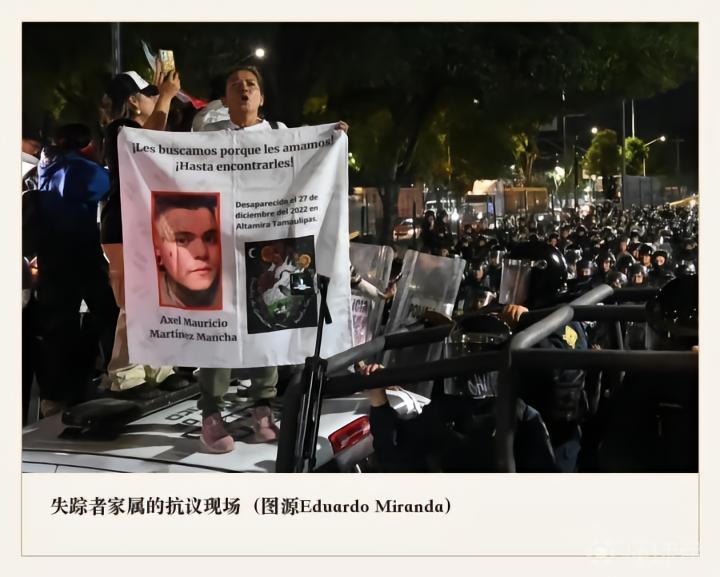
During the World Cup, the families of the missing children continued their protests, but crowd control measures imposed on them imposed further restrictions. On opening day, they gathered at the stadium entrance, where rows of police officers stood in their way, shields in hand, ensuring they could not enter the stadium. One mother of a missing child knelt on the ground, weeping and saying, "We just want our children back."
The officers did not remove her, but they also did not allow her to enter the “last mile.”
At the foot of the monument, Dania wanted to go over and hug the mother who was arranging posters. But they were separated by the crowd, and a reporter was interviewing her, so she didn't go over.
“Many people around me are not happy about Mexico hosting the World Cup. We all feel that the country is not ready and it may cause more chaos, and the Mexicans will have to bear the consequences themselves.”
Dana always passes through the Hidalgo metro station when traveling. This important transfer station in Mexico City made the news a month before the World Cup began. The local government renovated the metro station, replacing the walls with beige marble-patterned panels and decorating it with huge crystal chandeliers and classic wall lamps, turning it into a popular spot for tourists to take photos.
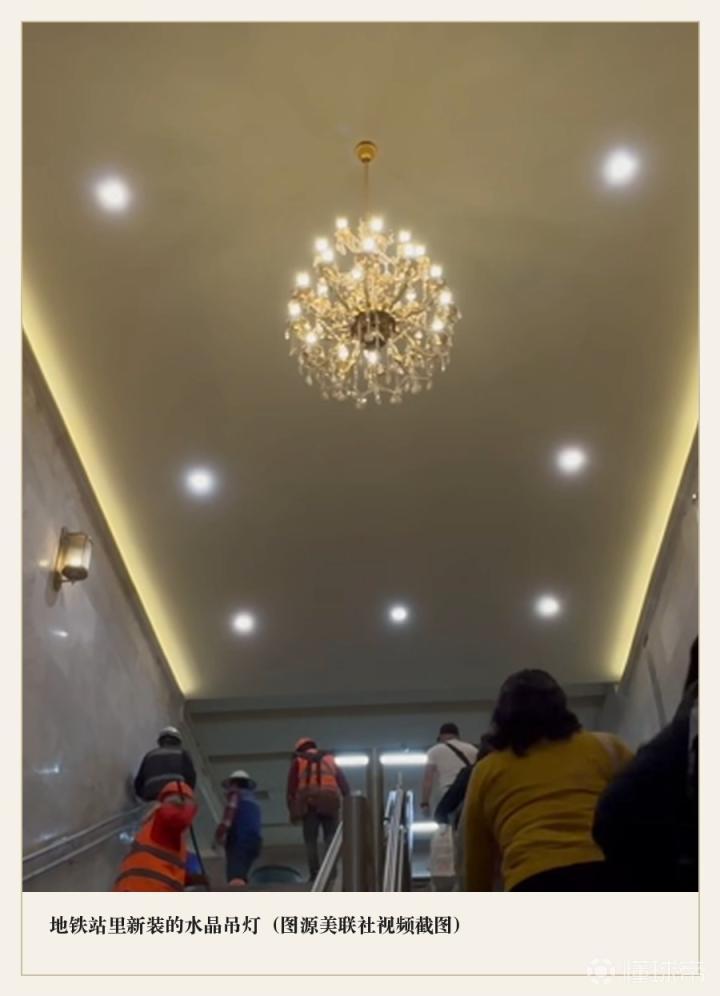
The crystal chandeliers, each costing 56,000 pesos (approximately 22,000 RMB), consist of four lamps. Other light fixtures range in price from 3,000 to 4,000 pesos each. Dania believes these are merely flashy decorations, intended to cover up the aging subway system and other problems, and are meant to impress foreign tourists. Furthermore, the subway line 2, which passes through this station, has been in operation for over fifty years, yet it only underwent its first major overhaul during this World Cup, with the government investing 1.5 billion pesos in support.
Renovation work continued, parts of the subway were closed, dust filled the air, and workers worked day and night to speed up the process. Passengers rushed around in the noise and chaos, making already busy transfer stations even more congested. Dania had to change her commute. "The whole transportation system is not very punctual or reliable to begin with. So when I'm forced to take an alternative route, sometimes I have to transfer several times. A journey that could be shorter, or has a fixed duration, just means you have to go through more trouble when they change your route."
Ten days before the World Cup opening ceremony, the station was still under construction. Dania saw the workers working even harder than usual to meet the deadline, which made her feel even more disgusted with the World Cup: "So many maintenance projects could have been done on weekdays, but they had to wait until the World Cup to start. They poured so much money into the project before the games started, and it's all a mess."
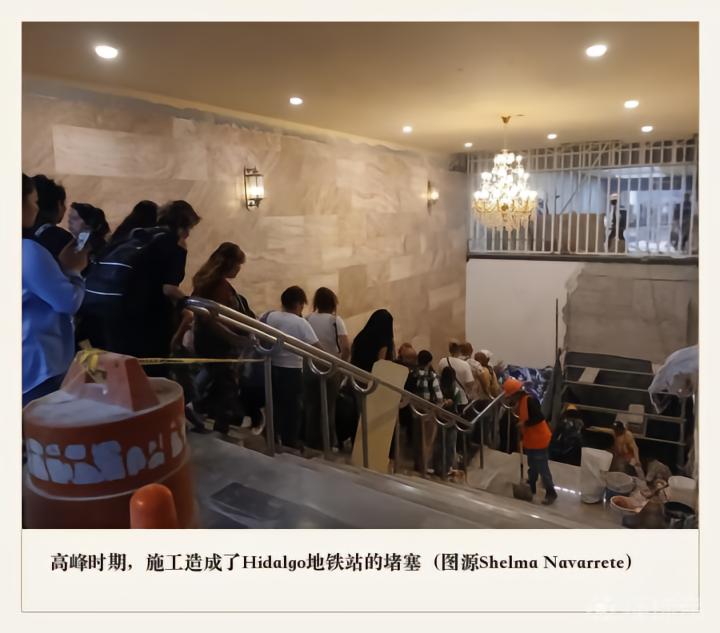
She distrusts the local subway system, and she remembers the breaking news on the night of May 3, 2021. A section of Metro Line 12 collapsed, killing 27 people and injuring 80. Prior to that, the affected section had experienced technical problems and had been temporarily closed. Repairs were carried out on the area after the 2017 Mexico City earthquake. However, in the years that followed, residents continued to raise concerns about safety.
In 2021, the Mexico City Attorney General's Office filed a lawsuit against the project's former head and 10 other former officials. However, the case remains unresolved. In 2025, a crack appeared in the repaired section of the road. The government and professional engineers stated that the crack was a normal construction expansion joint and posed no threat. However, the unresolved issue continues to cast a shadow over the lives of Mexicans.
The subway already terrified Dania, and with the construction and crowds of tourists during the World Cup, she now avoids taking the subway whenever possible and prefers to walk further to take the bus.
Subway decorations are just a small part of the vanity project. In Monterrey, the host city of the World Cup, the local government built walls and barbed wire fences right next to impoverished areas to ensure that tourists would not see poor people and dilapidated buildings.
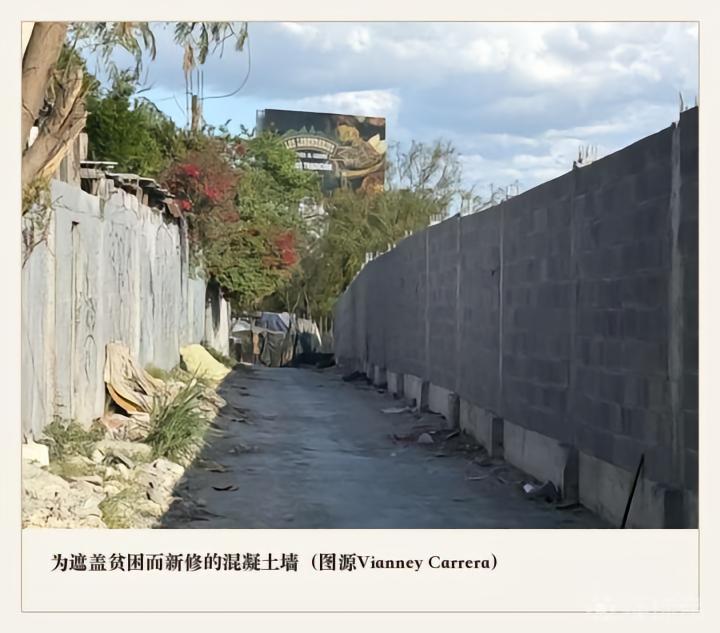
Near a poor local community, workers installed new wire mesh covered with greenery and hung welcome banners in Korean and Swedish. In other places, thick concrete walls were simply erected. In front of the barriers was the main road for tourists. Behind the barriers were bungalows built by local residents using sheet metal and wood.
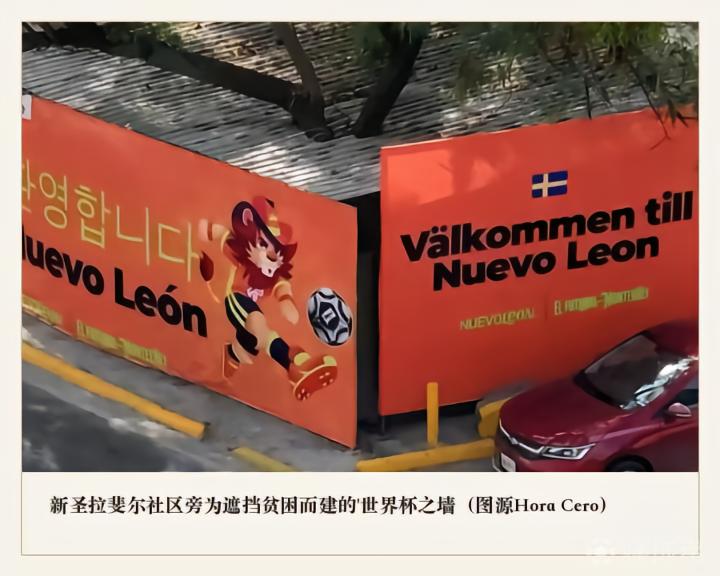
These barriers are known as the "World Cup Wall" and are also called the "Wall of Shame" by the public.
Dissatisfaction with the government's actions is one thing, but creating a festive atmosphere is another. Dania knows that no matter how badly the authorities handle things, Mexicans are naturally inclined to celebrate, and she wants to go out into the streets to see "where she can fit in and whether she can truly belong."
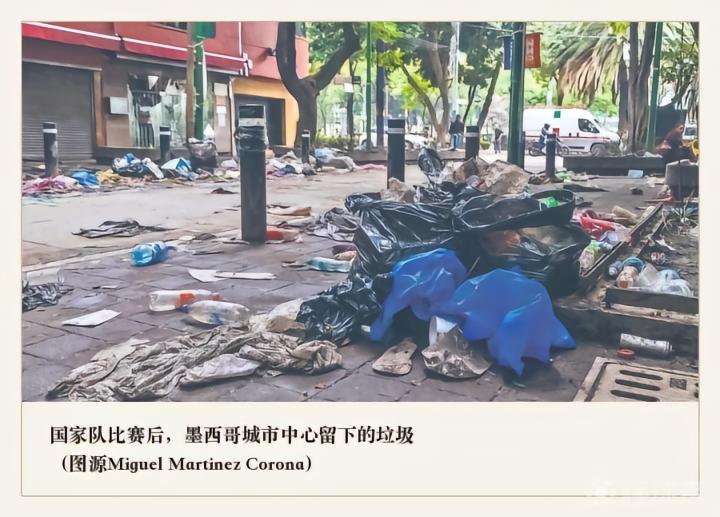
She and her friends watched Mexico's victory over South Korea, and everyone was very happy. After the game, she joined many citizens in celebrating in the streets. However, not long after she went out, she saw the celebrating crowd begin to vandalize public facilities. At the Angel of Independence monument, people sang and cheered, celebrating Mexico's victory, but soon fights broke out, and some people smashed cars parked nearby. The ground was littered with bottles, cans, and plastic bags, and flower beds and green belts along the street were also destroyed.
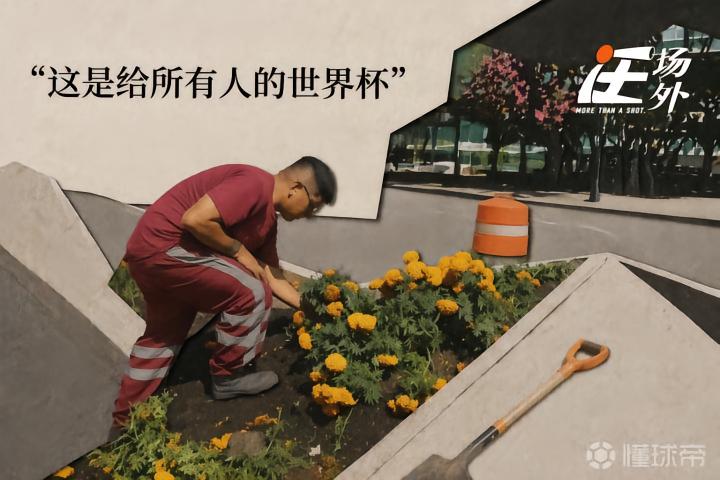
Dania quickly left the celebration crowd, returning home frustrated and angry. The following day, local media reported that the celebrations left 40 tons of garbage in the streets, requiring 360 sanitation workers to begin cleaning up from the early morning. Several shops suffered property damage amid the chaos and destruction.
Before the World Cup, local residents worried that the event might lead to overcrowding. Mexico City Mayor Brugada stated, "During this World Cup, we need everyone to work together to reduce traffic flow and congestion. We are making arrangements to close schools during these days. In addition, we also need to bring remote working back to the city; working from home will help us improve air quality."
These remarks sparked outrage among many Mexicans. The mayor had previously stated that this was a World Cup for everyone. Dana, however, viewed it as a World Cup for everyone (except Mexicans).
She began to avoid everything related to the World Cup. She stopped caring about the games and no longer wanted to go to celebrations. She chose to stay home on match days, "especially when Mexico was playing." If she absolutely had to go out, she would leave early to avoid any World Cup-related events.
The mayor's goal has been achieved.