
According to Xinhua News Agency, when reporters inquired about the progress of expanding the World Cup to 64 teams, FIFA did not provide a clear answer.
DALSA, July 13 (Xinhua) -- A Swiss media outlet recently reported that FIFA President Gianni Infantino said that after the USA-Canada-Mexico World Cup, the feasibility of expanding the World Cup finals from 48 teams to 64 teams will be formally discussed, adding that this idea should be considered "absolutely".
This statement quickly attracted widespread attention. After multiple verifications by reporters, it was confirmed that Infantino did indeed make such remarks. However, when reporters inquired further about the specific progress via email, FIFA did not provide a clear response.
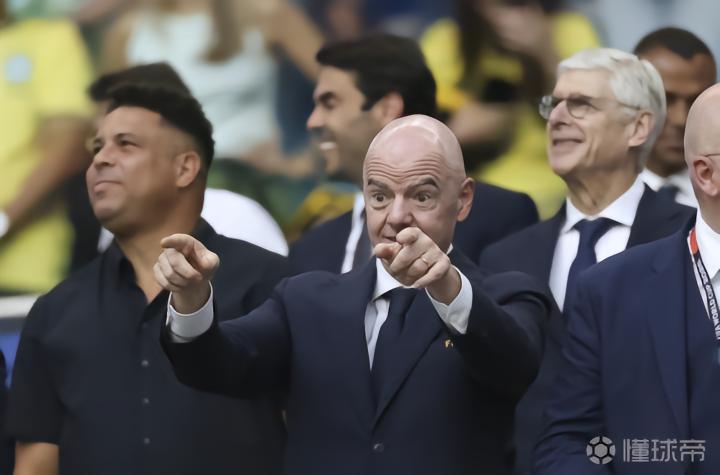
The photo shows FIFA President Gianni Infantino (center) at a match during the FIFA World Cup in the USA, Canada, and Mexico. (Photo by Xu Zijian, Xinhua News Agency)
Although the future of this topic remains uncertain, judging from the signals released by the FIFA president, expanding the World Cup to 64 teams is no longer just a speculative idea, but is entering a substantive discussion stage.
Why is FIFA so eager to propose a "further expansion" of the World Cup, which was just expanded in 2026? There are three main motivations behind this.
**Firstly, there was strong lobbying from CONMEBOL (South American Football Confederation).** CONMEBOL President Dominguez was one of the key figures who first publicly proposed expanding the 2030 World Cup to 64 teams. 2030 marks the centenary of the first World Cup, and South America had strongly advocated for bringing the tournament back to its home country. However, in FIFA's final plan, Spain, Portugal, and Morocco became the main host countries, with South America only securing three opening-stage centenary matches.
Dissatisfied, Dominguez subsequently expressed his support for further expansion on multiple occasions, receiving echoes from several South American member associations. He argued from a format perspective that a 64-team format (divided into 16 groups of 4 teams each) could effectively resolve the compromise and awkwardness of the current 48-team format, where "even the third-placed teams in eight groups can advance," and restore the rule of "the top two teams in each group advancing." Furthermore, the maximum number of matches a single team needs to reach the final would remain at 8, the same as the 48-team format, without adding extra pressure on top players. Of course, the more practical benefit lies in the fact that once expanded, CONMEBOL could not only host more matches by 2030, but almost all of its 10 member associations could also qualify for the main tournament.
On July 7, players from the Colombian national team warmed up before their Round of 16 match. (Xinhua/Zou Zheng)
Secondly, the enormous commercial potential is a major driver. The World Cup has always been FIFA's core revenue engine. During the 2022 Qatar World Cup cycle, FIFA's total revenue was $7.6 billion; however, with the expansion to 48 teams, the estimated revenue for this year's USA-Mexico World Cup has already soared to $13 billion, an increase of over 40%. If the expansion is further expanded to 64 teams, the number of matches, broadcasting rights, and sponsorship rights will inevitably experience another explosive growth.
The photo shows the scene of a match between the African team Ivory Coast and the South American team Ecuador. (Photo by Cao Can, Xinhua News Agency)
Thirdly, the performances of the newcomers to this World Cup have boosted confidence. Previously, there were widespread concerns that the 48-team format would widen the gap between strong and weak teams and dilute the quality of the competition. However, the performances of newcomers like Cape Verde and Curaçao in this tournament have dispelled many doubts with their better-than-expected results. Gianni Infantino stated, "Teams from every continent have scored goals and at least earned points. Nine out of ten African teams have reached the knockout stage. This precisely demonstrates the importance of giving more teams the opportunity to participate."
In Infantino's logic, the expansion aims to break the European and South American monopoly on the football landscape and stimulate development in relatively underdeveloped regions. A deeper factor is that Infantino will seek re-election in March 2027. Under FIFA's "one association, one vote" presidential election mechanism, expansion clearly benefits smaller non-European associations and helps solidify Infantino's voter base in Asia and Africa.
On July 3, Cape Verde, a newcomer to this World Cup, celebrates a goal in their Round of 16 match against Argentina. (Photo by Zhang Chen, Xinhua News Agency)
However, the opposition is equally significant. During the USA-Mexico World Cup, UEFA President Ceferin sharply criticized the 48-team format, publicly stating that too many teams resulted in a large number of "uninteresting" matches in the main tournament, implying that the influx of weak teams diminished the competitive quality of the World Cup as the highest stage of football.
Based on the commercial success of the Champions League and the top five European leagues, UEFA has long maintained the belief that "European football is the center of the world," and naturally opposes the 64-team proposal that could potentially take away from the clubs' commercial profits. Even stronger resistance may come from the top European clubs that pay star player salaries and the International Federation of Professional Footballers (FIFPRO). Currently, national (regional) team and club competitions are closely linked, and many clubs and players have complained of being overwhelmed, criticizing FIFA's actions to increase the number of matches and expand the World Cup. If the World Cup is further extended and the number of matches continues to increase, the conflict between FIFA and the European Club Association (EFC) and FIFPRO regarding player protection and club compensation may escalate further.
Against the backdrop of polarized public opinion, the transition from a concept to reality for the 64-team World Cup is far more complex than a simple "show of hands" decision; it involves a multi-faceted struggle encompassing politics, economics, schedule, and logistics.
According to the FIFA Statutes, any attempt to modify the competition format requires FIFA to complete a rigorous process of "motion, evaluation, consultation, and voting." The authority to determine the competition regulations, format, and allocate slots is explicitly granted to the FIFA Council, a 37-member body comprised of the President, Vice-Presidents, and continental council members.
First, a motion needs to be formally proposed by the FIFA president, council members, or some member associations. This stage is mainly to set the tone and test the reactions of all parties.
After deliberation, the motion will be included on the official agenda at a FIFA Council meeting, and the Council will appoint the FIFA Secretariat, the Technical Working Group, and other relevant bodies to conduct a comprehensive assessment and feasibility study on the adjustment of the international competition calendar, logistical support, financial and commercial prospects.
The next crucial step is FIFA's negotiation with stakeholders. On one hand, it needs to negotiate with the continental football federations to redistribute the quotas, garnering their support through a fair "divide of the pie." On the other hand, it needs to negotiate with organizations such as EFC and FIFPRO to reduce opposition by increasing club subsidies.
Generally speaking, a new tournament format will only emerge after negotiations have made real progress. The decision to expand the World Cup will only take effect if the new plan is approved by the council (by a simple majority or by consensus).
On June 17, FIFA President Gianni Infantino (second from left) watches a group stage match from the sidelines. (Photo by Xiao Yijiu, Xinhua News Agency)
Looking at the decision-making process for expanding the World Cup to 48 teams in the last round, from Infantino's motion in April 2016, to the FIFA Council's formal discussion and evaluation in October 2016, and then to the Council's unanimous approval of the World Cup reform plan in January 2017, the whole process took about 9 months.
At the FIFA Council meetings, Infantino's ambitious plans did not always proceed smoothly. In 2021, he strongly advocated for a "biennial World Cup" reform, but it was met with strong resistance because it seriously affected the interests of the continental football leagues, and was ultimately shelved during the negotiation stage.
Based on this analysis, the next round of World Cup expansion is still in the preliminary discussion stage. The last round of expansion had a buffer period of nearly ten years, while this time, if it's to be implemented by 2030, there are less than four years. It's foreseeable that this game will not be simple.
The draw for the group stage of the 2025 FIFA World Cup (United States, Canada, and Mexico) was held on December 5, 2025. (Photo by Wu Xiaoling, Xinhua News Agency)
If the expansion to World Cup becomes a reality, the global football landscape will undergo profound changes: on the one hand, more Asian and African teams will realize their dreams, and the preparation methods of each team will be adjusted accordingly, potentially leading to more "dark horse stories" in the World Cup; on the other hand, with nearly one-third of FIFA member association teams entering the main tournament, the prestige of the World Cup qualifiers may decline, and the entertainment value in the early stages of the main tournament may be diluted.
Furthermore, organizing the World Cup will be unprecedentedly difficult. The need to accommodate 64 teams and require at least 16 to 20 modern stadiums means that, except for a very few major countries, it will be almost impossible for a single country to host the event, and multinational co-hosting will become the standard practice.
Is this proposal to expand the World Cup to 64 teams a dream for inclusive football, or an overly commercialized gamble? The curtain has been raised on this game of strategy.