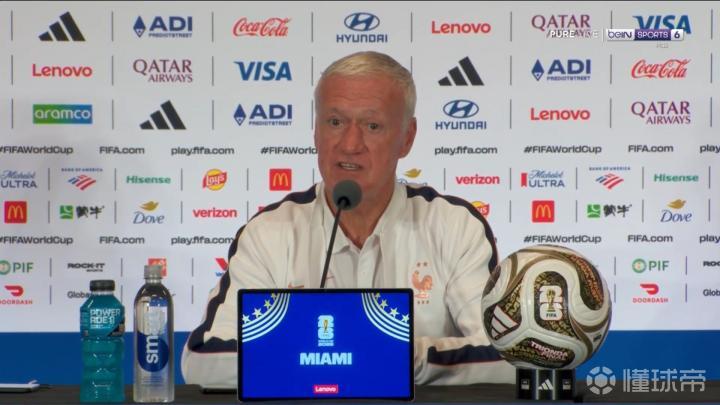
At 5:00 AM Beijing time on July 19th, France will face England in the World Cup third-place match. On the eve of the match, Didier Deschamps, the head coach of the French national team, attended a press conference for his final game as manager. This article is the first part of that press conference.
Related Reading
Hello Didier, I'm sorry, how are you feeling before your last match after 14 years coaching the national team? How have you spent these past few nights since Tuesday's match?
I feel a sense of responsibility for this upcoming match. This isn't a friendly, it's not a match we'd prefer to play, but it exists—it's a match for third place. So, my team, the players, and I all have a responsibility to do everything we can to achieve this final goal. The goal may not be that important, but I repeat, whether the English want to play or we want to play, the match is there, it's arranged, and there's a goal. So, that's what's on my mind right now.
As for my nights, obviously, they're wonderful when there's victory, smiles, and joy. When that's not the case, it's not so pleasant, but you have to accept it. And I don't know if you understand, but just in case, I'd like to tell you again. After that, I'll answer questions about the match, the last match. Spain performed better than us, and paradoxically, statistically, in terms of athletic performance—that is, running distance and intensity—our numbers were very good.
So the problem lies in another area, which is certainly partly our responsibility—namely, the technical field. This is undoubtedly due—not to, but to—the strength of this Spanish team; they raised the bar. Taking all these factors into account, the result is… Spain advanced, and we didn't. This disappointment is proportional to our legitimately held ambitions. That's it, but we have to accept it. We still have this match ahead, and after that, they need rest, and so do I.
Hello Didier, do you have any regrets about this match against Spain? Do you feel that some things could have been done differently?
Regret, in essence, is about choices? I had some decisions to make, and I've made them. Perhaps I can revisit this, because I know you'll likely have other questions afterward. First, there's Adrien Rabiot, and Willian Saliba's injury is clearly a concern as well. He's been examined, and his injury hasn't worsened. Unfortunately, he's been carrying this injury since March. So he's been managing it, gritting his teeth and persevering, which tests his pain tolerance. And now, unfortunately for him and for us, the pain has reached an unbearable level.
Then there's Adrian, and I might go on for a bit longer, which I like to do. First, let me talk about my relationship with Adrian and the others. During the first water break, he came up to me and said, "Coach, I can't play properly anymore. I can't play my own game. Please forgive me." But I could understand, because I was a player myself, and I've twice been in a situation where I had a yellow card in the semi-finals.
The situation is different now because yellow cards are reset. But I still remember that it also had something to do with my position. When you're a midfielder, the game is 360 degrees; threats can come from all directions—attack, defense… that's how it is. Adrian had a yellow card on his record, and I told him to control himself and avoid holding the team back, because that could have terrible consequences. Once, his defensive action almost got him a card.
Going back to what I was about to tell you, I've been through those situations, and I felt like my own shadow. Because you're always playing with the brakes on, with the sword of Damocles hanging over your head. Should I deprive one of the best players of that game of their opportunity to play? After that, the risk needs to be assessed, and there's a substitution window after halftime, but this won't be counted as a substitution.
So, could I have done things differently? Yes, I don't know what would have happened if I had. But I stopped asking myself "what if I had made this decision?" a long time ago. My choices were based on my judgment at the time, combined with the circumstances and my own experience, while also taking into account all the information I had—and you can't have everything. After that, there's plenty of room for interpretation.
It's like when I asked myself if I was going to be eliminated, I talked a lot about the referee, but I didn't fully explain it. I was just raising a question, but that doesn't mean the referee was the reason we lost the game. Everyone will have their own analysis and interpretation of the subsequent decisions. I wouldn't say that the referee eliminated us against Spain; that's never been on my mind, but some decisions could have been different. As a former player, I'm very aware of the potential consequences, that's all.
But the primary analysis is: they played better than us, and they deserved it. Argentina, yes, both teams. Both teams deserved to be in the final. Why? Because, like us, they beat all their opponents. Reaching this point means they deserved it; they deserved it because they defeated their opponents. Now we have one last dream opponent: England tomorrow. Sorry, I've gone on and on.
Hello Didier, you mentioned that tomorrow is the last goal to be achieved. Ibrahim Konat spoke before you, and he seemed a bit worried about the team's lineup. Will you be making rotations?
Worried? No, he wasn't worried.
Will you make extensive rotations? Or will you retain your key players?
Listen, I won't go into the details. I know you're always most interested in this before a match. Anyway, after about 17 minutes of training this afternoon, you'll know who starts and who doesn't. I've spoken to all the players, including those who have never played before. The only important thing for me is that no one is playing just to fill a spot. These 26 players are my picks; I could have chosen others.
So whether they play very little or not at all, I see it as a responsibility, a responsibility as the national team coach, to do everything I can with my team to achieve our goals. I hope we can do it, but the important thing is to give it our all, and the same goes for the players. Later, I learned of a word, I don't know when it was coined—the famous "barber" (substitute). In a match, there are no substitutes, that's all.
So, based on the personnel situation I have, some players are unavailable, and others are unavailable due to their special circumstances. However, I don't want to delve into these details because I don't want to disclose my conversations with the players. So, will I make a large-scale rotation? How many players constitute a large-scale rotation? I don't have all the information yet, but yes, I will make adjustments. Firstly, because some players are unavailable, and secondly, for other reasons as I understand them, these will influence my starting lineup choices.