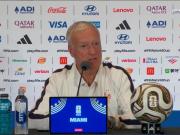
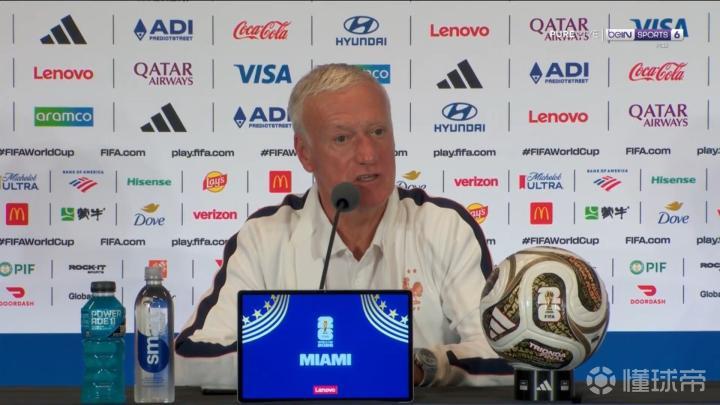
At 5:00 AM Beijing time on July 19th, France will face England in the World Cup third-place match. On the eve of the match, Didier Deschamps, the head coach of the French national team, attended a press conference for his final game as manager. This article is the third part of that press conference.
Related Reading
Hello, you previously mentioned that Kylian Mbappé is available for selection, and that putting him at his best to become the tournament's top scorer could be a motivational tool for you. On the other hand, for some players, there might not be any particularly good motivational tools available. Could we take advantage of that?
There are always motivational methods; you'll analyze the players who will be on the field and what they'll do. While I won't consider these things—because it's not my business—Kilian doesn't need any external motivation. However, it's reasonable for him to have this personal goal. Although he may have other things on his mind, these can lead to different decisions. Based on what has happened, this is the end of the story.
This is the final battle, but it's not an insignificant one. It obviously won't change their lives, but it's still a competition. We need to understand that third place is better than fourth. So I repeat, first and foremost, it's me, my team, and I who will do everything we can to achieve this goal, and as captain, he will too.
Hello, Didier, despite my disappointment, and putting aside your choices and the lineup for this match, to continue the question my colleague just raised, how do you motivate these players and the whole team who weren't even planning to play this game? What will you rely on, or what will you say to them? Of course, you'll have your speeches, that's in the private space of the locker room, but I know you'll also have many conversations with them individually or collectively…
No, wait a minute. My principle is: okay, it's difficult, but we can't complain. How many teams were already home before the semi-finals? Forty-four. So we're still here. This isn't a game we wanted to play, a game we hoped to play, but we still have one more game to play. That's the reality. And when you put on this jersey, it's a responsibility. I've already said it goes back… to around August 2012. We have a responsibility, when you come to the French national team, not to ask for anything. We have a responsibility, and I will impose this on myself, on my team, and the players must have this sense of responsibility.
I don't know if this will happen... I won't predict, I don't know. We will do everything we can to make the game go smoothly. This responsibility exists because wearing this jersey means taking responsibility—a responsibility to the millions of French men and women who support us, are excited for us, and are disappointed in the younger generation. It's not a question of setting an example. But I've always believed that whenever I come here—and I've been here for 25 years—the first thing is responsibility. And now we bear that responsibility, just like every time, even if it's a so-called "meaningless game"—not this one, but a friendly or any other game—we have that responsibility, that commitment.
Good afternoon, Coach. In your many years of professional career, whether as a player or as one of the best coaches in the world today, do you think... even though we're not playing the final now, but rather a game for third place, do you consider Mbappé to be the best player in French history?
Comparing players from different eras is difficult; it's a generational gap. For today's 15- and 20-year-olds, the most important players are those participating in this World Cup. For "old folks" like me, they definitely prefer 1998 and 2018—those were very important moments—it's just a generational divide. But okay, one victory can't be compared to another, you can't equate one victory with the previous two.
Hello Didier, putting aside the very special context of this match, what is your personal mindset right now? After all, this might be your last match as manager, on television?
Yes, yes, that's clear, thank you. No, in my heart, yes, but I know very well that this final curtain call is tomorrow. I don't need to make anyone cry, and I do n't think anyone here will cry. I know I'll miss the French team, but to have been in this position for 15 years, to have worn this jersey, to have experienced so many glorious moments and so many difficult ones, that in itself is a privilege, and that's enough. The moment of reckoning has come, that's it.
But life goes on. I don't know what the future holds, but I'm naturally optimistic, and I know the future will be bright. But even so, the French national team, and everything it has given me in my career, is the best thing I've ever experienced; it has occupied 25 years of my life. For a man or a woman, 25 years is a long time; it leaves its mark, perhaps even a deeper one. Because obviously, it leaves unforgettable memories. But the most important thing is always what's in front of you.
Didier, you often talk about this, and you just talked about the sense of responsibility that Ibrahim (Konaté) has to face the media. Kilian also spoke out frequently during the World Cup, but since the defeat, we haven't seen the core players come out, which is inexplicable. How do you explain this?
Is it simply a lack of explanation? How can I explain? There are too many mandatory obligations after that, and I will try my best to bring them. Even if these are limitations I can't control, I can't blame FIFA. But at times, things are indeed complicated. I believe in Kylian and the other key players; they are all here, fulfilling their responsibilities. As for you, I'm sorry, are you here just to provide explanations? Post-match mandatory matters are not my responsibility, nor are day-to-day operations; these are important, but we will try our best to meet the requirements.
Okay, I don't know. Killian was there at the time, maybe not with you guys. I don't know, they had to...
Yes, and I don't know. Then things changed… so the question you're asking now is a little different. I know, I can explain in detail, we had to conduct up to 32 interviews with the broadcasting rights holders, who had priority to request interviews with specific players. I don't know, it is indeed a little different. I'm sorry, it's really difficult for me to answer this question because I don't know who specifically spoke to whom, or what they said.
So, aside from that reason, I can understand how you feel if you weren't able to interview the person you wanted to interview afterwards. Like that rather awkward situation before the match against Morocco, where they didn't get enough questions. Of course, this isn't about your situation, but well, all sorts of things can happen after a match. This is the media world you live in, even though it all revolves around the match, and it's a very time-consuming task. We've tried our best to handle and meet all the requests. If we weren't able to meet 100% of everyone's expectations after the match, I can understand that too.