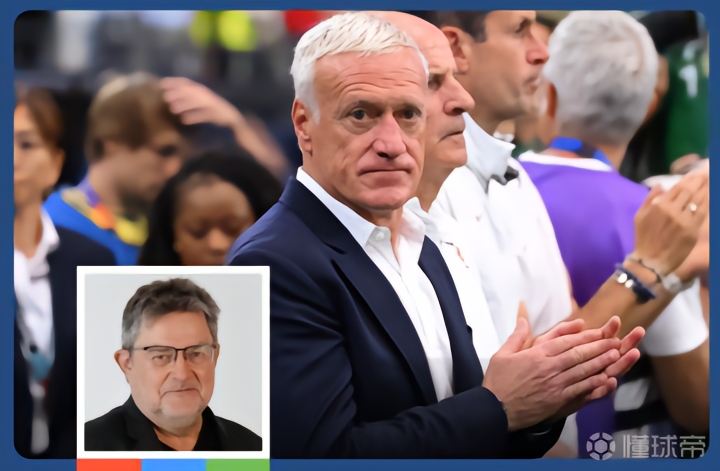
As Didier Deschamps' national team career draws to a close, Vincent Duluc has written an article praising the legendary French national team coach. Despite facing much controversy, one World Cup title, three major tournament finals, and fourteen years coaching the French team make him arguably the greatest coach in French national team history.
Full team report
In his final days in charge of the French national team, Didier Deschamps has again resorted to oversimplifying the reasons for the defeats and branding himself as the "culprit." This is part of his job, at least until Saturday night's World Cup third-place match against England (11 pm). But there's no doubt we must look beyond these last four days and examine his entire coaching career—the longest-serving coach in French national team history, on the eve of his 185th match in charge of the team after 14 years.
No one can stay that long. Because this isn't life. The more than ten years of coaching Les Bleus, just like in Matignon, involved enduring the dual pressures of media and public opinion, sharing victories with others, and bearing defeats alone.
Didier Deschamps is one of only three people in world football to have won the World Cup as both a player and a coach (the other two being Zagallo and Beckenbauer). His achievements extend far beyond one title in seven major tournaments; the teams he led often performed better in their later stages than their initial ones: in the last six tournaments, he led his teams to the final three times and the semi-finals five times. However, Tuesday's 0-2 semi-final defeat to Spain mirrored the initial expectations. Perhaps this job means being willing to make mistakes in principle, and using three defensive midfielders is just as likely to draw criticism as using two.
He may have been somewhat conservative in the past, or perhaps somewhat radical now, but that's all. He's been heavily criticized for much of his coaching career, accused of being a defensively dull coach, because cautious tactics are easily associated with empty rhetoric, given his perceived lack of attacking talent—and sometimes these criticisms are indeed valid. He's considered overly conservative, yet he consistently maintains a 50% turnover rate in his World Cup squad, promoting young players without hesitation. His ability to adapt to change is something he prides himself on, even if it means clashes with some players, including some big names and prodigies.
He may be a victim of a kind of attrition, one that is not necessarily of his own making: his overly rigid style is tiresome, both in the collective performances of the French national team and in his carefully controlled public statements. He maintains an air of absolute control, extending his contract through private meetings with Noël Le Graët. This fuels suspicions about his control over the French national team; the coach and helmsman meet regularly, the final outcome often decided after the qualifiers, or even before the final results are announced, and imposed upon everyone. At times, he may struggle between the desire to continue winning and the desire to extend his coaching career, but Deschamps may be able to balance both.
His fourteen years in charge coincided with an explosive increase in controversy and a decline in rational analysis within the football world. The world had changed: in 1998, Aymé Jacquet was unchallenged, and any criticism would lead to public humiliation on July 13th; by 2018, questioning a World Cup-winning coach was possible. The Deschamps era reflected this: he was able to defuse media debates with clear articulation, maintain close ties with the broader French national team community, and consistently uphold a commitment to serving the public.
Of course, to truly achieve great success, he could have departed with a splendid legacy, like Michel Hidalgo after Euro 1984 or Jacquet after the 1998 World Cup. Both coaches were younger than he is now and never coached again. However, he suffered the most painful and earliest defeat of his career: being eliminated by Switzerland in the Round of 16 of Euro 2021 (3-3, 4-5 on penalties). Due to the pandemic, that Euro was the only time Deschamps failed to fully demonstrate his summer managerial prowess: typically, this month allows him to put into practice the true essence of his profession—building a team and establishing a shared vision.
He may not be the best, but from any perspective of history, considering the stature of Michel Hidalgo (1982 World Cup semi-finalist, 1984 European Championship winner) or Aimee Jacquet (1996 European Championship semi-finalist, 1998 World Cup winner), Deschamps' place among the top (and one of the top) coaches in the history of the French national team remains unshaken. If France ultimately finishes third in the World Cup, then this is how he will bid farewell to football this Saturday in Miami.
Link to this article
Source: https://www.lequipe.fr/Football/Article/Il-a-dure-il-a-lasse-mais-il-a-surtout-beaucoup-gagne-didier-deschamps-tire-sa-reverence-en-tant-que-plus-grand-selectionneur-de-l-equipe-de-france/1705216