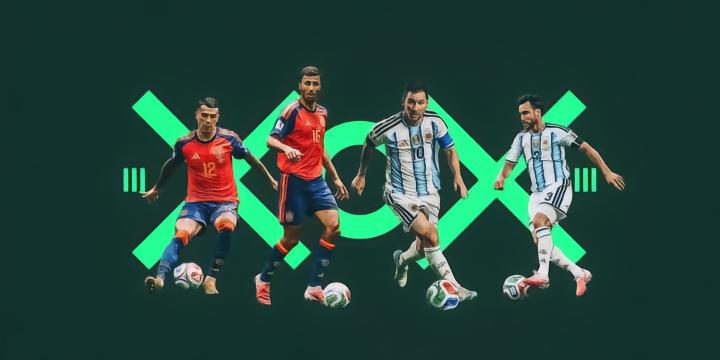
At 3:00 AM Beijing time on July 20th, the final of the 2026 USA-CMC FIFA World Cup will be held at the New Jersey Arena in New York, featuring defending World Cup champions Argentina against European champions Spain. Prior to the match, renowned sports media outlet The Athletic used data models to predict the final outcome. The results indicated that Spain would have a slight advantage.
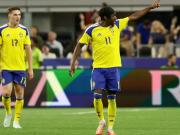
This is the only blemish on Luis de la Fuente's near-perfect run in this World Cup – they have never trailed in a match so far, conceding only one goal in seven games, which was in the quarter-final against Belgium.
Possession-based style is deeply ingrained in Spanish football culture, and captain Rodri is the best embodiment of this style: he has completed 655 successful passes, the most of any player in the World Cup finals since records began in 1966. His center-back teammate, Cubas, is second with 550 successful passes. Even more impressive is the 19-year-old's exceptional ability to carry the ball forward and deliver incisive passes to midfield, averaging over 22 passes per game to break through the opponent's defense with a 94% pass completion rate—the best record in this World Cup.
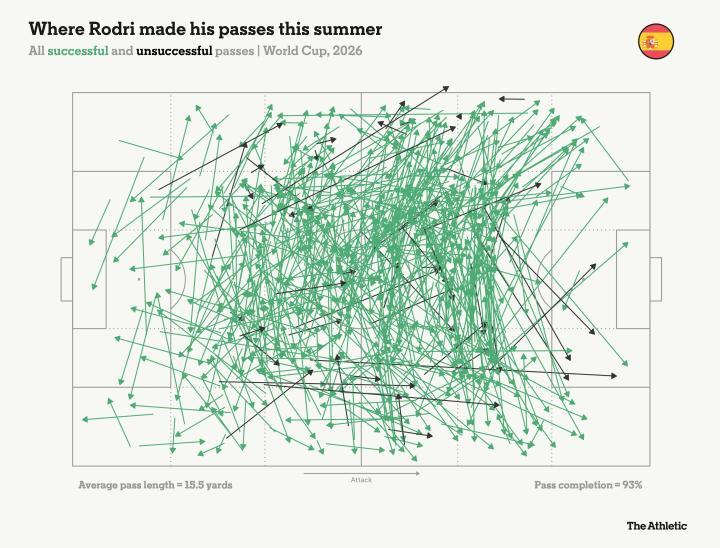
Rodri's passing route distribution map for this summer's World Cup
From any perspective, these data are sufficient to illustrate the point.
Spain averages 28 consecutive passes of 9 or more every 90 minutes, ranking first among all participating teams in this World Cup. The value of this consecutive passing is multi-dimensional.
On the one hand, sustained possession can gradually wear down the opponent's stamina—opponents who can't get the ball for a long time will be compressed into their own half, their legs will become increasingly heavy, and their thinking will gradually become chaotic; on the other hand, this possession advantage is closely related to the Spanish team's rare defensive agility after losing possession. De la Fuente's team performs exceptionally well in counter-pressing, immediately surrounding the ball carrier to quickly regain possession and continue the attack to suppress the opponent.
According to FIFA data, Spain spent 12.2% of their time off the ball in this World Cup in the counter-pressing phase, the highest percentage among all teams that advanced to the quarterfinals. Besides controlling the tempo when in possession, Rodri also led all players in the tournament with the most successful counter-pressing wins.
The 30-year-old's resilience can be glimpsed in the following example: In the 3-0 victory over Austria in the World Cup qualifiers, when Yamal lost possession in the Austrian penalty area, Rodri quickly pounced on Sabitzer, decisively intercepted the ball, and then looked up to see four teammates in red jerseys in passable positions. Spain's tactical style is flexible, adaptable to transitions between attack and defense, and capable of accelerating the pace of the game—taking advantage of brief periods of disarray in the opponent's formation.
This can be seen from their ball possession turnover frequency (i.e., the number of times possession changes hands) and attacking efficiency: 31% of Spain's attacking runs result in them penetrating the opponent's penalty area.
Combining the two, the threat posed by the Spanish team goes beyond long periods of possession; their style of play is multifaceted and lethal.
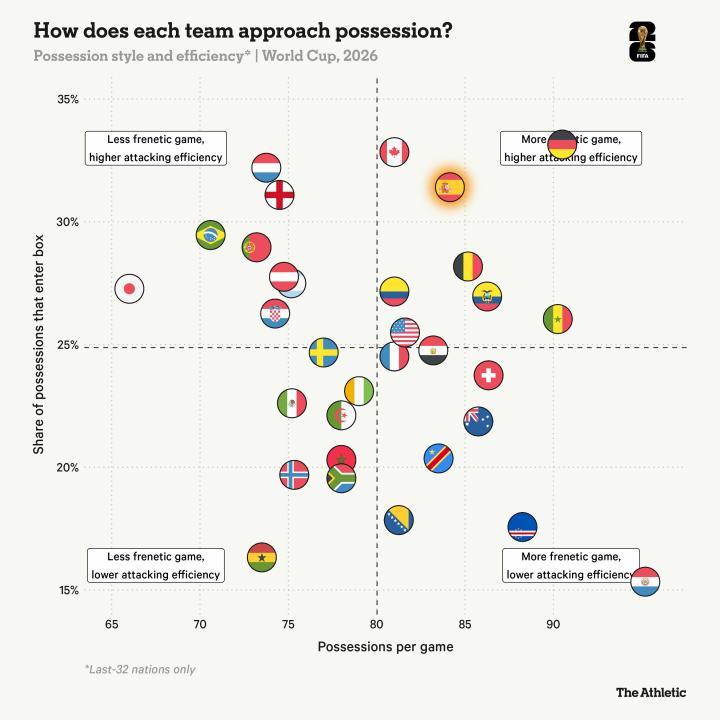
Analysis of each team's ball possession style | The horizontal axis represents average ball possession per game, and the vertical axis represents the percentage of possession sessions that penetrate the penalty area.
Yamar is a gem for the Spanish team, but after recovering from a hamstring injury at the end of last season, the young player's goal-scoring threat in this World Cup has not been as high as expected.
Although Yamar's dribbling skills and delicate footwork can instantly change the course of a game, the real core of the Spanish team this summer is the team's cohesion – the result of years of practice: in the semi-final starting lineup against France, seven players had also started in the 2-1 victory over England in the European Championship final two years ago.
Spain's squad consistency is sometimes comparable to that of a club team. De la Fuente has worked with many of the current players during his decade-long tenure coaching the Spanish youth system.
A key tactical feature of the Spanish team in this tournament is the use of full-backs.
Whether it's cutting inside, overlapping, creating chances, or scoring crucial goals, Cucurella and Pedro Porro have played a significant role in Spain's attack.
Cucurella and Baena's rotation and cooperation on the left flank was perfect. The two always occupied different channels on the field, thus stretching the opponent's defense and creating gaps. This was demonstrated to the fullest in the semi-final victory against France.
Throughout the tournament, the same rotation tactic was also used in the second round of the group stage match against Saudi Arabia, where the two players used reverse movement to pull the opponent out of their defensive positions and put pressure on the opponent on the flanks.
The tactical pattern on the right flank is exactly the same. Polo's winning goal against France is a perfect example of how the wingers cooperate tacitly and give full play to their strength.
Yamal stayed in the outermost tunnel, drawing French left-back Lucas Digne over, which created space for Polo. He completed a brilliant one-two with Olmo before cutting inside into the central tunnel.
The "added-value full-back" tactic is a major trend in this World Cup, with full-backs or wing-backs acting as "extra players" to support the attack and surge into the opponent's penalty area. Porro, who scored 2 goals in 7 matches, is a perfect example of this tactic, often partnering with Yamal and demonstrating excellent coordination with his teammates. Considering the roles of Argentina's full-backs on both ends of the pitch, the tactical balance on Spain's flanks could be a key factor in the final.
Let's start with Argentina's weaknesses in off-the-ball defense—of the defending champions' seven goals conceded in this tournament, five stemmed from defensive errors on the flanks. As shown below, three of these goals were conceded from Argentina's left flank in similar scenarios: against Jordan, Egypt, and England, passes from the opponents to the edge of the six-yard box were not successfully cleared.
There were also two goals scored after the opponents easily broke through the flanks: De Duarte of Cape Verde and Ndoye of Switzerland both used exquisite passing to get past their respective Argentine full-backs before scoring from a tight angle inside the penalty area.
Given Spain's efficiency in combining plays on the flanks, Argentina's coach Scaloni and his coaching staff must be highly vigilant and try to contain Spain's flank threat, as this has been their Achilles' heel throughout the tournament.
On the offensive end, apart from right midfielder Giuliano Simeone (who has started in 2 games in this World Cup), Argentina's attacking line has no players with natural wing attributes.
This means their full-backs – typically Tagliafico (left) and Molina (right) – need to take on the task of widening the pitch. Pressing Argentina's two full-backs back into their own half is an effective tactic to reduce their attacking threat, but Scaloni's team is better at utilizing the technical abilities of Messi, Enzo Fernandez, Julian Alvarez, and McAllister to create passing combinations in the middle.
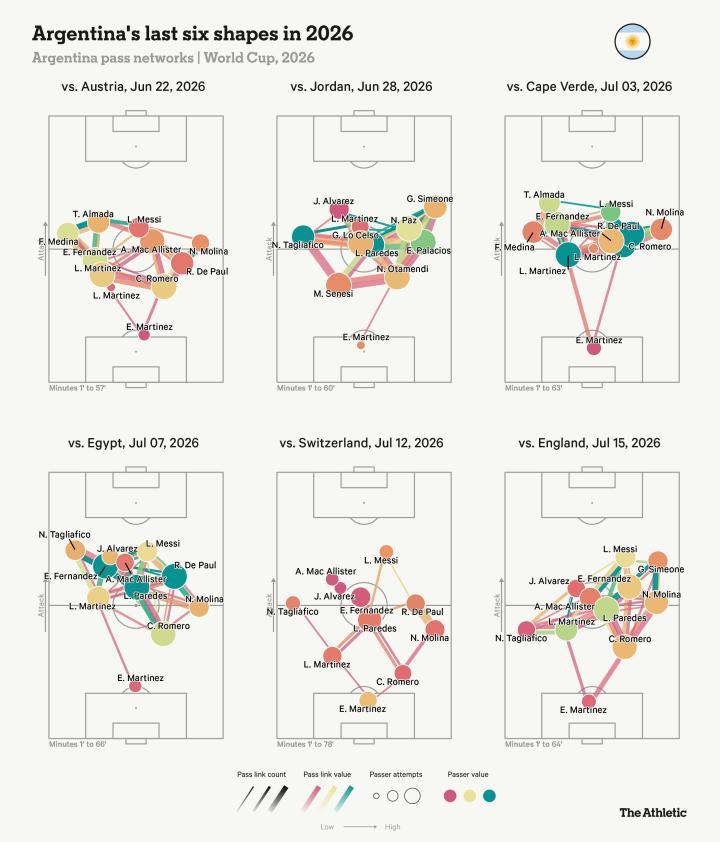
Argentina's formation and passing network diagram for their last six matches in the 2026 World Cup
In the attacking half, Argentina had the highest percentage of touches in the central midfield at 33%.
Their narrow formation was intentional, aimed at finding openings in the middle of the opponent's defense. They attempted 40 through balls in this tournament, the most of any team. In the outermost attacking third, Argentina's attacking percentage was only 42%, second only to South Africa's 39%.
This is largely thanks to Messi.
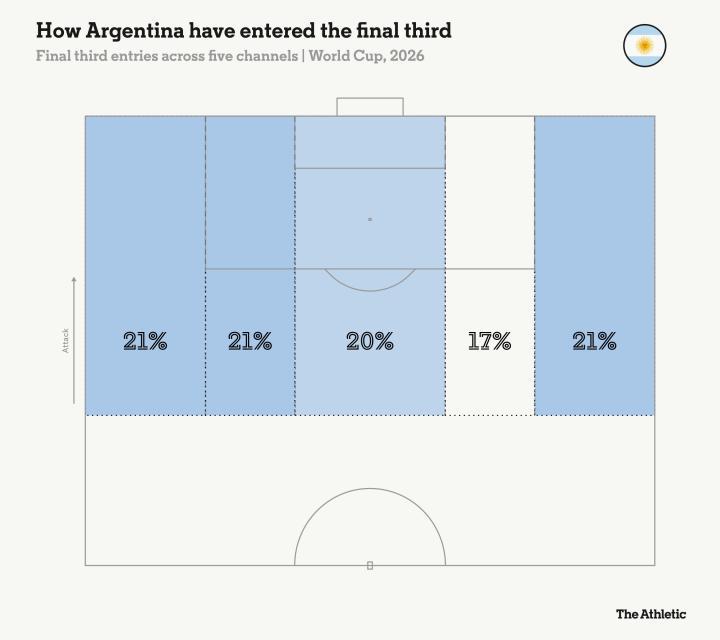
How will Argentina advance into the attacking third?
This 39-year-old player continues to defy convention with his extraordinary performance: he strolls leisurely in the opponent's half, then suddenly bursts into action, delivering a fatal blow. Although he spends 64% of the game walking, no player in the world is better at optimizing his running timing than the Argentine captain.
The data is sufficient to highlight his central position.
Of all the players who advanced to the round of 16, Messi created 33% of his team's total chances, a figure unmatched by anyone else; in terms of the percentage of non-penalty shots in his team's total shots, only Norway's Haaland (29%) surpassed Messi's; and in terms of the percentage of touches in the attacking third in his team's total touches, only Morocco's Achraf Hakimi (19%) surpassed Messi's.
If it wasn't obvious enough before, it's now certain: all of Argentina's tactics still revolve around this agile "magician".
Tactically, Messi has the freedom to roam anywhere on the field, looking for openings to strike. Sometimes he drops deeper to participate in organizing attacks. Other times he drifts to the left flank, operating in the open areas there.
In the semi-final against England, he stood firmly on the right flank and then provided two assists in the final stages of the match, helping Argentina complete the comeback.
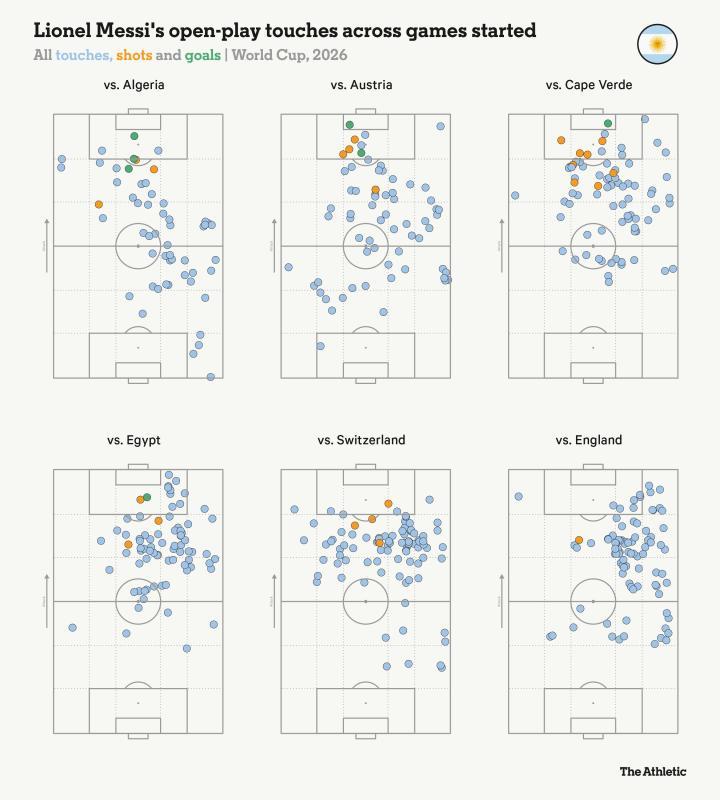
Messi's touches in open play across all starting appearances
In this tournament, Messi has contributed a total of 12 goals (8 goals and 4 assists), more than any other player, and he is expected to lift the World Cup trophy for the second consecutive time.
This might sound like a cliché, but perhaps all Spain can do is hope that Messi is out of form tomorrow. Because Messi is Argentina, and Argentina is Messi.
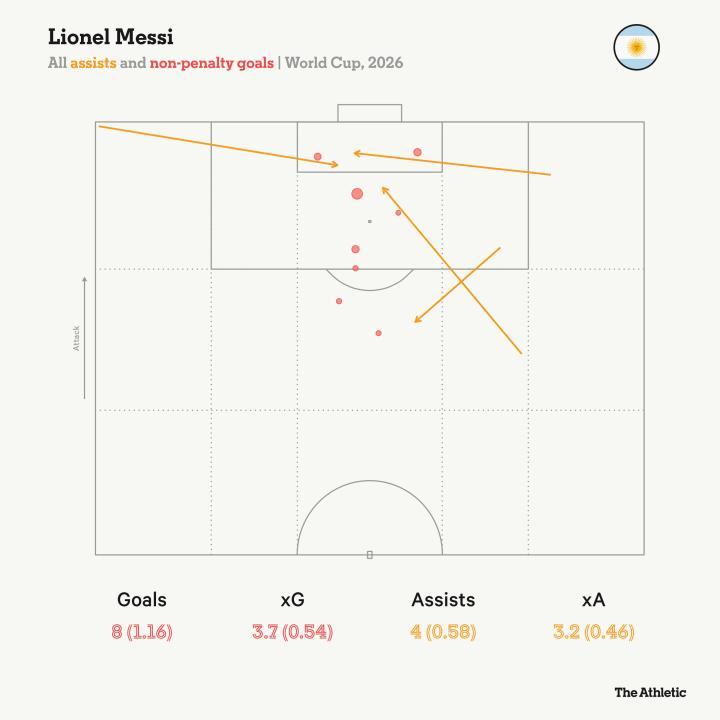
Messi's all assists and non-penalty goal locations at the 2026 World Cup
In their three appearances in the finals of the last four World Cups, Argentina has repeatedly relied on Messi to lead the team to victory. In contrast to Spain's near-perfect record, the defending champions were trailing for 14% of the tournament, double the 7% trailing time Qatar spent winning the title.
Many teams understand that Argentina should never be declared out prematurely, because they will fight to the very last moment. Of Argentina's 19 goals in this tournament, 12 were scored after the 75th minute (including goals in extra time), and 9 of those goals changed the course of the game (equalizing or taking the lead).
That's why the outcome of this final was so unpredictable.
Sunday's final will be a clash between the two teams currently ranked number one and number two in the FIFA world rankings, and will also be the first time in World Cup history that the reigning European champions and the Copa America champions will compete for the title.
The Athletic's prediction model favors Spain, giving them a 59% chance of winning, compared to Argentina's 41%.
Both teams have rarely lost in recent years: Spain's last official defeat was in a European Championship qualifier away to Scotland in March 2023, and they eventually won that European Championship; Argentina, on the other hand, has not lost in the knockout stage since losing to Brazil in the 2019 Copa America semi-final, and has since won three major tournaments in a row.
Tomorrow, one side will inevitably lose their unbeaten streak. May the best team in the world win the World Cup.