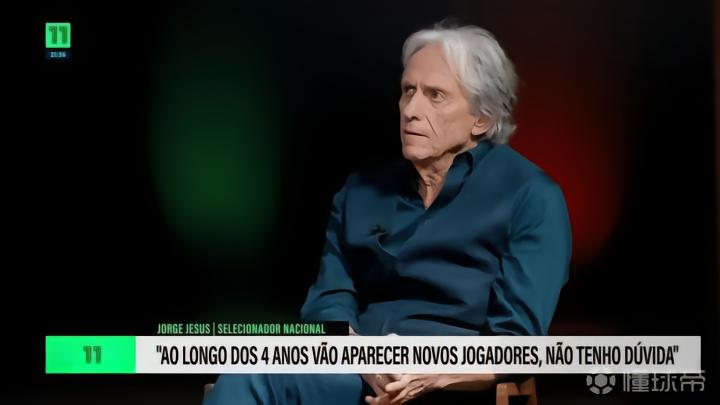
Portugal's new coach Jorge Jesus gave an interview to Canal 11, discussing his new phase in managing the Portuguese national team. This article is the second part of the interview.
Related reading:
Jorge Jesus: I don't teach players how to play, but rather I help them understand my philosophy.
You just mentioned that the midfield combination is different, and you also stated that Portugal's midfield is not the best in the world. So, does this midfield have the potential to become the best in the world?
They possess that potential and have the potential to become one of the world's top midfielders. We can't say this midfield is the best just because the players are individually talented. It must be demonstrated in matches and proven through performance. However, I think Spain performed exceptionally well in this World Cup.
Portugal has a number of players with both quantity and quality in these positions. Using a three-man midfield would offer more options. However, with a two-man midfield, one player would need to shoulder more positioning and defensive responsibilities, which is essential for my team; the other would require stronger attacking capabilities. This narrows down the pool of choices, considering both the number and characteristics of the players.
You said in 2014, "The national team head coach is not responsible for training, but only for selecting players." Has your opinion changed now?
There's no change. Club coaches are essentially the same; they also need to select players from their squads. The first ability a national team head coach must possess is the ability to select the best players. As a coach, your first task is to select the best 11 players; the essence is the same.
The difference lies in the fact that clubs have more training time and can impart more information to players. Training and teaching are different. Some coaches simply organize training sessions, while others truly understand how to teach. Modern technologies also allow us to conduct tactical drills in advance, without even entering the stadium.
Do you think the team's performance will double after you bring these changes?
Logically, that should be the case. If Portugal can't perform better than they did in the World Cup, I can't achieve better results. We must play better. If we can't improve, then we're just continuing to live with a dream.
This situation has persisted for many years, not just in this World Cup. We have many excellent players, but not many championships. We have won the European Championship, which is an honor, even though it was 10 years ago, we still won the title.
We've also won the UEFA Nations League. Many people think it's not the most important competition, but in reality, it's the hardest to win because the final stages are comprised of the strongest teams in Europe. Last year it was Portugal, Spain, Germany, and France. And then Argentina joined us for the World Cup. Of these teams, Argentina, France, and Spain all reached the semi-finals.
National team coaches typically don't want to see their football associations publicly state their championship aspirations. What's your opinion on the Portuguese Football Federation's current attitude?
This is also related to my personality. I had a fantastic time in Brazil. If you're coaching the Brazilian national team, you can only think about how to win, how to become world champions; you have to think that way. The players will give you signals and make you believe that this goal is achievable.
Portugal has won the European Championship and has a lot of players. I wouldn't say they are the best players in the world, but they play for the world's top clubs, which is another matter. As for whether they are the best players, that's another question. But they do play for the world's and Europe's top teams.
This gives us confidence and makes us believe that Portugal has the potential to win the World Cup and the European Championship. In this World Cup, we were eliminated in the round of 16, and everyone thinks that team could have performed better. If I couldn't make the team play better, the result wouldn't have changed. That's a fact.
What goals has the Football Association set for you?
My biggest goal is the 2030 World Cup held in Portugal, and that's my goal too. I'm very proud to coach my country's national team. Furthermore, the prospect of the 2030 World Cup being held in Portugal is always before us, and we can strive for that opportunity.
We have all the necessary conditions. In the teams I've coached, there are usually no other options. Whether it's Flamengo, Benfica, or Sporting CP, a coach can't just say, "Let's go for the title." It's not "strive for the title," it's "must strive for the title." The same applies to the national team; the overall philosophy is to win. As for whether we ultimately win, that depends on the game itself.
Does the UEFA Nations League help you build your team?
For me, the change in schedule this year is more favorable. We will be playing four or five games in a row, which helps me get things done. In the past, it was usually one or two games, then the players would return to their clubs and then regroup.
Now that we'll be playing consecutive matches, I can keep sending them messages during this time.
Some might say, "There's a game every three days." That's fine. Some players will play, some won't. We still have training time, we can continue working, and we're laying the foundation for the future.
Let's continue discussing the current format of the UEFA Nations League.
For me, this format is better. I can spend more time with the players, about 15 more days working together. In the past, players would return to their clubs from the national team with different philosophies, including training methods, game strategies, and communication styles.
The situation is different now. I work with the national team, and when players come here from their clubs, their philosophies may be similar, but their training methods are different. Therefore, these 15 days are very important for us.
Portugal will next face Wales, Norway, and Denmark in succession, with the latter two being very physically demanding. What strategies does Portugal employ to counter these opponents?
Norway eliminated Brazil in the World Cup, Denmark has many players playing for top European clubs, and so does Norway. They even have one of the best center forwards in the world right now, Erling Haaland. We already know the strength of these teams.
As for physical condition, that's a factor to consider, but it won't change my assessment of the game's philosophy. Physical contact can have an impact at times, but technical ability and tactical understanding can often provide an advantage.
You previously seemed to downplay the impact of players' self-esteem. So, what kind of character do you hope the Portuguese team will possess?
A winner's mentality is essential. Players must share this spirit and demonstrate competitiveness in matches. To be stronger than opponents, one cannot rely solely on technically gifted players, nor solely on tactically capable coaches.
A team must possess sufficient character to be truly competitive. This is crucial. It can only be achieved when a team has character, unity, and prioritizes collective interests over individual ones.
Every roster announcement attracts attention. Can fans expect a relatively fixed lineup, or will it be adjusted based on player form?
The selection will be based on the players' form. The next roster will be announced in September. Since the team was eliminated in the Round of 16 of the World Cup, some might say, "The new coach will come and replace everyone." That won't happen; I won't do that.
Furthermore, we don't have enough time for a large-scale overhaul, and our player selection pool isn't that large. I have no doubt that new players will emerge in the next four years. However, in the short term, the roster won't change much from the World Cup squad. There might be two or three new players, but no major adjustments.