The TA's seven reporters each selected their top 11 players, with only one rule: each country could only select a maximum of two players. This limit on the number of players from each country also allowed some lesser-known names to be represented.

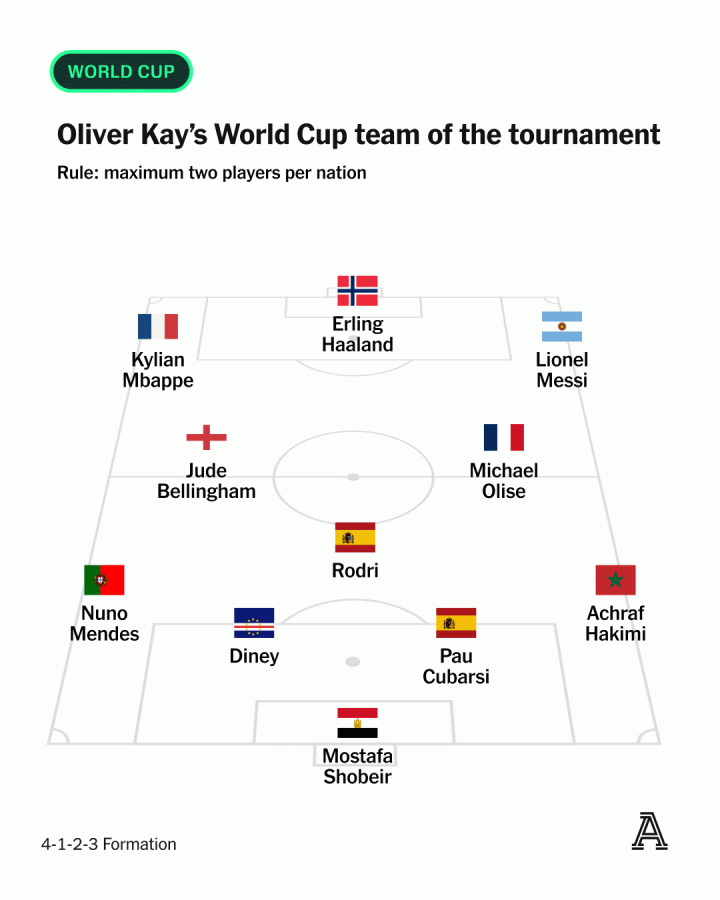
Oliver Kay
The two-player limit per country significantly impacts the defense; otherwise, this position might have been dominated by Spanish players. I selected Spanish captain Rodri and young center-back Cubasi, which is somewhat cruel for Pedro Polo, Laporte, and Cucurella.
The most obvious alternatives at center-back were Cristian Romero and Lisandro Martinez, but while they both had moments of brilliance, I felt they were somewhat inconsistent in the knockout stage victories against Cape Verde and Egypt. I opted instead for Dinwi, who performed exceptionally well in the group stage against Cape Verde, particularly in the 0-0 draw against Spain.
In the goalkeeper position, many would vote for Voznia. He delivered a brilliant performance for Cape Verde and is worth watching, but I think Egypt's Schubert is a better contender.
The front six are almost naturally formed. Even without the quota, the lineup wouldn't change much. It seems a bit surprising that Argentina and England only selected one player each, but I think the real openings are in the four defensive positions, and neither team's defense is particularly solid. They rely more on Messi and Bellingham.
Harry Kane and Dembele also have their reasons for being selected, but it's hard to exclude the attacking trident of Messi, Haaland, and Mbappe.
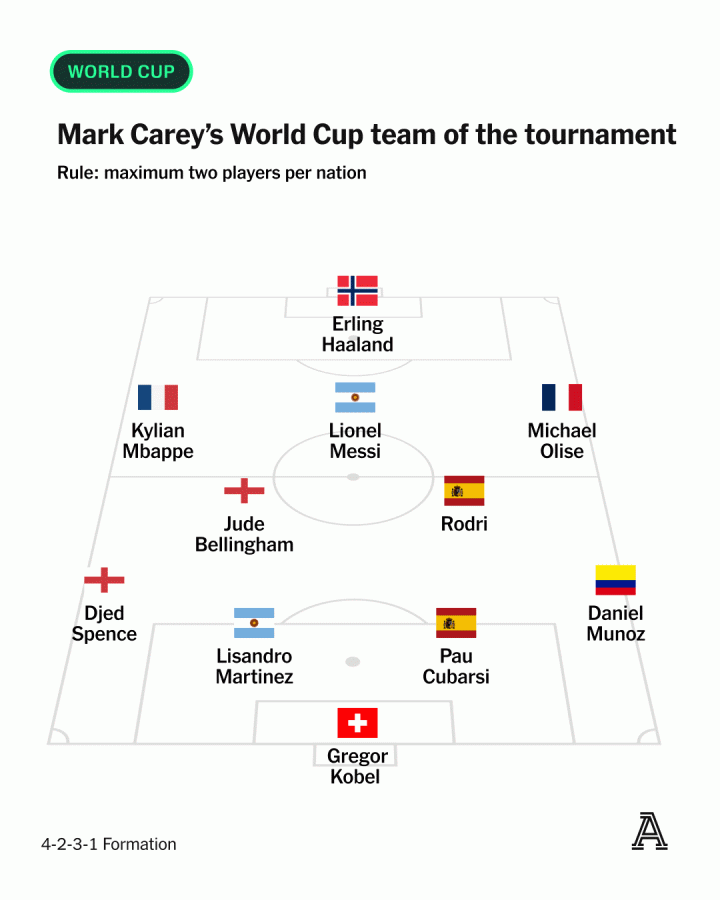
Mark Carey
This is a less common, data-driven choice, but Swiss goalkeeper Schubert deserves recognition because his saves exceeded expectations—he conceded four fewer goals than expected for the quality of the shots, a figure higher than any other goalkeeper.
Muñoz's wide-ranging forward runs and frequent attacks into the penalty area were a delight to both Colombian and Crystal Palace fans; on the other side, England's wing-back Spence solidified his position with some memorable attacking and defensive moments. Kubasi and Martinez were able to stabilize the defense when the full-backs pushed forward, and both players delivered excellent passing throughout the tournament.
Rodri's selection was no surprise, but from here on, the lineup becomes a bit... offensively oriented.
I placed Bellingham in a deeper midfield position, as he occasionally did this summer, so Messi could play as a number 10 ahead of him. The two scored a combined 15 goals, but their creative contributions to the team's attack came primarily from the midfield area.
I moved Olise back to the right wing from his central position this summer, while Mbappe was moved from the center forward position to the left, because he would frequently roam into those areas anyway.
This allows Haaland to play in the center, where he displayed incredible efficiency in his first World Cup appearance.
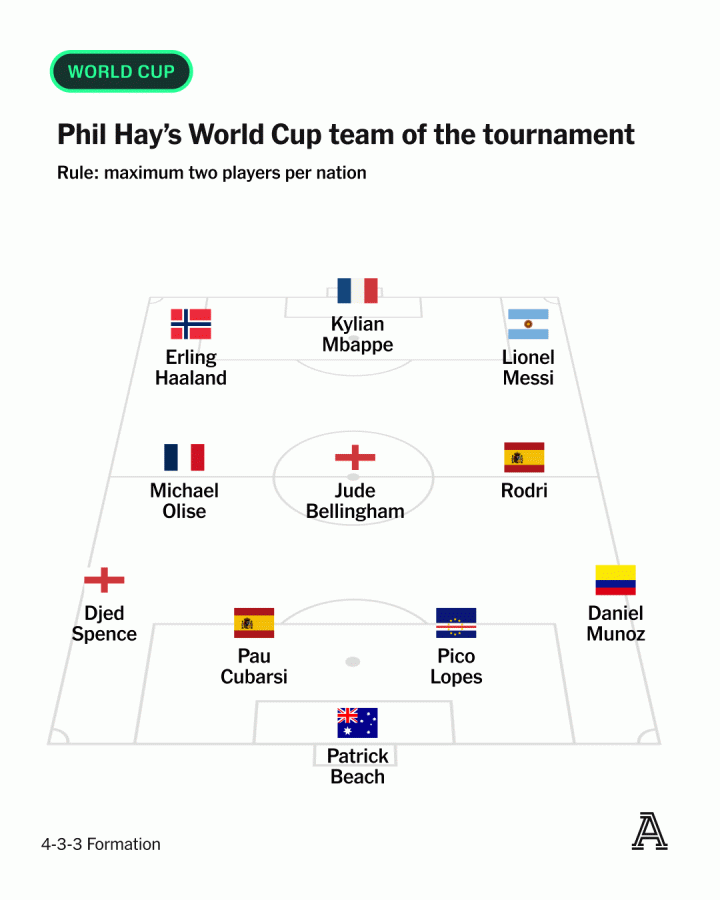
Phil
The World Cup is dominated by the most famous names from the very beginning, so it's not easy to pick a lineup that doesn't follow the rules.
Messi, Mbappe, and Haaland all needed to be in the forward line. The three scored a combined 25 goals. Rodri, as the tournament's best player, certainly couldn't be overlooked, and his performance was back to Ballon d'Or level. Bellingham and Olise were equally influential and couldn't be ignored.
However, I'd like to make a slight change in defense – except for Cubasi, who should still be in every best XI. Muñoz scored a brilliant goal for Colombia, and the right-back was full of energy before the team's round of 16 loss to Switzerland. Lopez gave his all for the lovely Cape Verde, while Spence matured on the international stage for England. He was one of the biggest surprises of this World Cup.
To be honest, Cucurella should have been the left-back and Unai Simón the goalkeeper, but the rules meant I had already filled all my Spanish player slots. So I chose Australian Patrick Beach as the goalkeeper, and there were good reasons for that choice.
Amélie Clayden
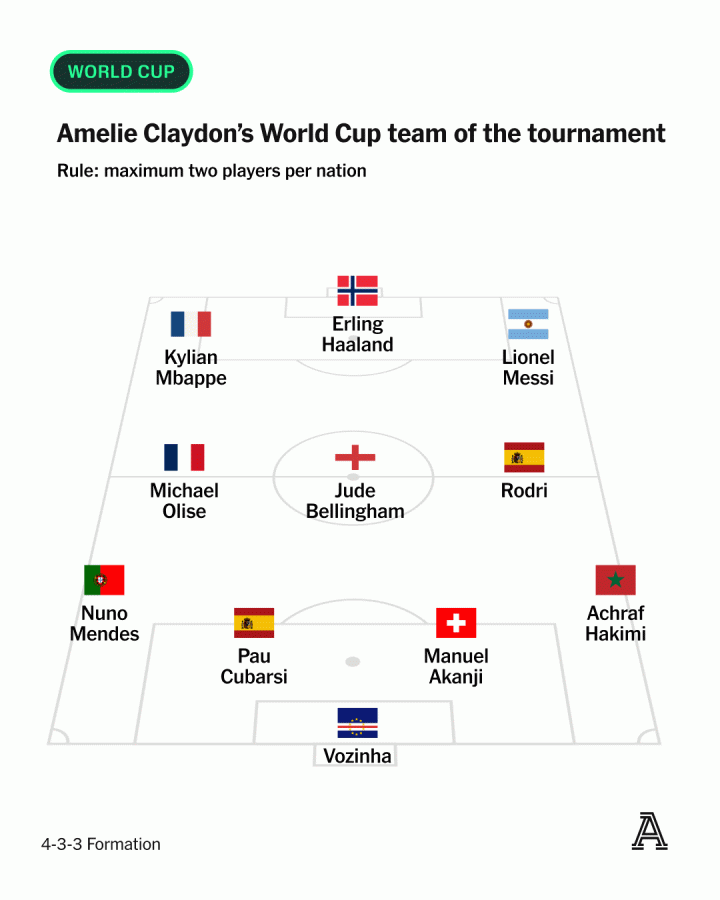
Rodri was the foundation of the team. The Ballon d'Or winner controlled Spain's path to victory, completing a record 790 passes throughout the tournament. His positional discipline also allowed Bellingham and Olise to push forward more freely. Mbappe was equally indispensable, winning the Golden Boot with 10 goals, while Messi remained the team's primary creator.
Cape Verde goalkeeper Voznia showed the significance of the World Cup expansion and contributed one of the most touching stories of the tournament. The 40-year-old former electrician made seven saves in the 0-0 group stage match against Spain, and then eight saves against Argentina, helping Cape Verde drag the defending champions into extra time.
Achraf Hakimi and Nuno Mendes provided top-notch speed and recovery ability, allowing Messi and Mbappe to drop into the middle without narrowing the flanks. Akanji provided stability and experience between the two, while Cubasi, after winning the Best Young Player award, secured Spain's second spot with a performance that helped them concede only one goal in the championship.
Haaland provided a focal point for the attack, and his seven goals helped Norway reach the quarterfinals. His running and physicality also created space for Messi and Mbappe.
Bellingham also scored 7 goals, but his selection wasn't solely based on those. His pressing, late runs into the box, and midfield balance were equally crucial. Olise finished with 7 assists, becoming the tournament's top assist provider and ultimately earning a place in the trio.
It's a shame that Kane wasn't on the roster, but if he were selected, the forward line would make the system, which already has three top finishers, too crowded.
Colin Millar
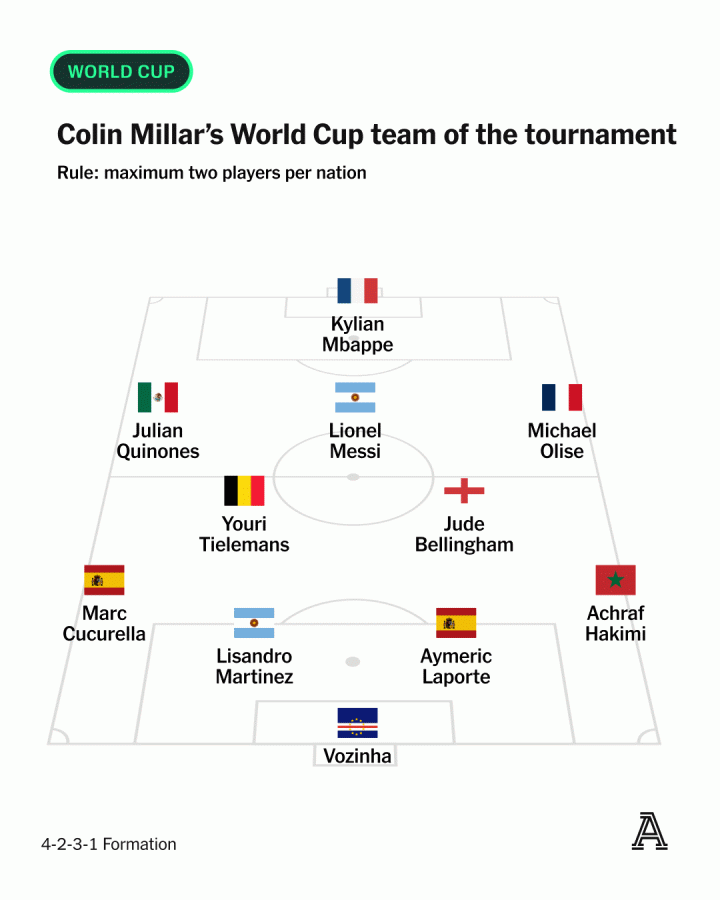
Until the quarterfinals, this World Cup was dominated by star players: mainly Messi, Mbappe, Olise, Bellingham, Haaland, and Kane. In the semifinals and final, these obvious names failed to score, which ultimately led to Spain's victory: a team whose collective performance outweighed individual contributions.
The spotlight may be on Spain's captivating midfield, but their overall performance throughout the tournament—conceding only one goal in eight matches and allowing just 10 shots on target—was built on an exceptionally strong defense. Their positioning, discipline, focus, and technical skill were clearly superior to other teams.
Voziña is the most compelling story of this tournament, and Cape Verde is the only team capable of stopping Spain. Their performances in the opening match and the loss to Argentina can only be described as heroic.
Quiniones was the most outstanding player among all the host country players, scoring in four of Mexico's five matches, including several spectacular long-range shots.
Iranian goalkeeper Beiranvand, Norway's Ødegaard, Switzerland's Manzambi, Cape Verde's Lopez, Senegal's Sarr, and Ivory Coast's Jan Diomande all deserve special mention. Oh, and the entire Spanish starting lineup.
George Edwards
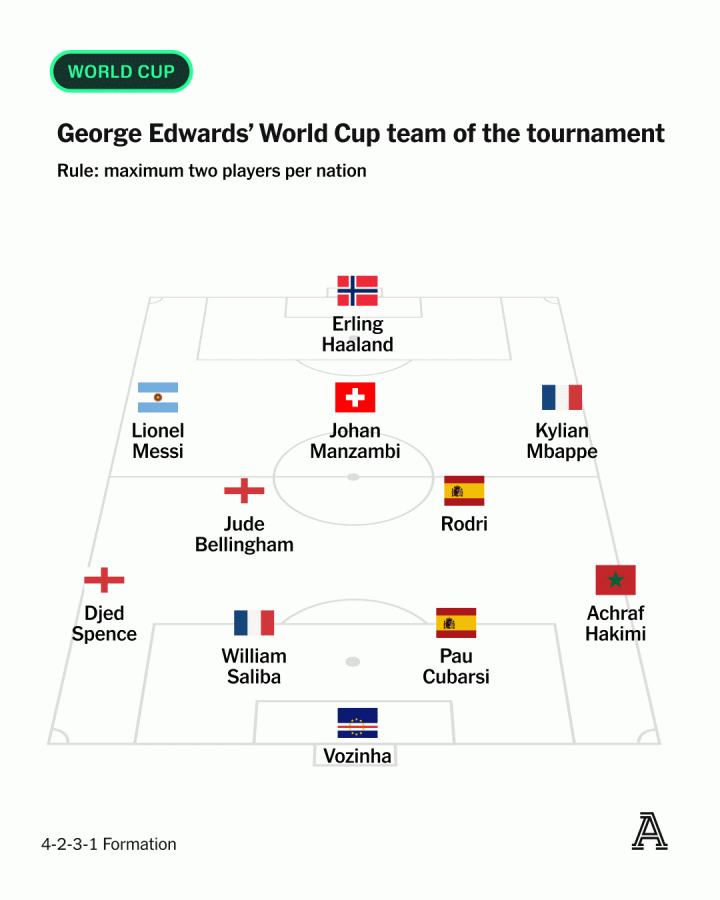
The stories of underdog victories in this World Cup may seem distant now, but they were precisely what made the early stages of the tournament so exciting. 40-year-old free agent Voznia, representing Cape Verde, ultimately became the only goalkeeper to prevent Spain from scoring.
Kubasi displayed composure in both dribbling and defensive maneuvers, rightfully earning the Best Young Player award. Although Saliba never fully returned to his peak form, France only truly showed defensive quality when he partnered with Upamecano in the backline.
On both flanks, the presence of Achraf and Spence helps the team advance forward; the former's speed in recovering and the latter's one-on-one ability also protect this already offensively oriented lineup.
Rodri consistently makes the right decisions in any situation, and his increasing presence as the game progresses proves that Spain is maturing. His composure allows Bellingham and Manzambi to freely roam between midfield and attack.
Mbappe and Messi need no explanation; they constantly refreshed and broke records throughout the World Cup. Haaland's stubborn number 9 positioning and instinct in front of goal provided the team with the sharpest weapon.
This lineup is very offensively oriented and relies heavily on Rodri's support, but since it's impossible to select all 11 Spanish players, balance can't be taken into account.
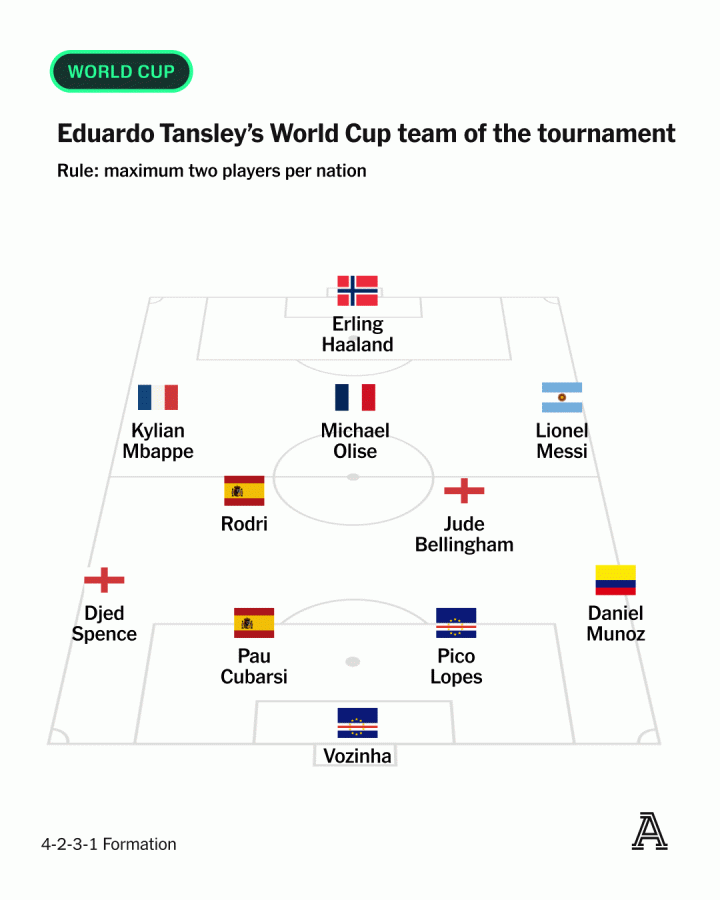
Yannick Eduardo Tansley
Rodri was the first person on the list; he won the Ballon d'Or, became the tournament's best player, and led Spain to victory.
I must use both of Cape Verde's spots, because they are the fairytale protagonists of this tournament: unbeaten in the group stage, including a 0-0 draw with Spain, and able to compete head-to-head with Argentina. The votes have already proven it; Voznia and Lopez deserve it.
On the defensive front, Spence didn't start every game, but after fans questioned Tuchel's choice, he ultimately proved himself to be one of England's most valuable contributors. Kubasi, at only 19, performed very solidly in Spain's defense; Muñoz scored two goals, helping Colombia top Group K ahead of Portugal. Considering Spain only conceded one goal, I really wish they could have allowed more Spanish defenders inside.
Both Bouadi of Morocco and Merino of Spain were contenders for the midfield position, but there were simply too many options for the forward line.
Kane is also one of the best players in this tournament, but I ultimately chose Mbappe and Messi, who scored the most goals in the tournament, as well as Olisé, who holds the assist record.
In his first World Cup, Haaland led Norway to the quarterfinals, scoring 7 goals and eliminating Brazil, which also sparked considerable controversy.
Bellingham scored the winning goal in England's match against Norway, and no England player has scored more than his seven goals in a single World Cup.