
According to The Athletic, England fans are angrier than ever after the World Cup, despite the team's relatively good performance in the tournament.
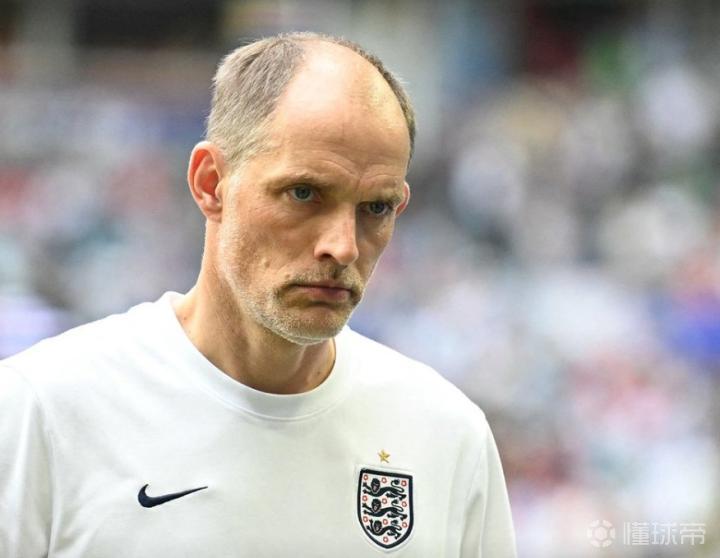
England lost to Argentina by one goal in the semi-final, a result that, on paper, is perfectly acceptable.
However, head coach Thomas Tuchel's tactical and personnel adjustments in the second half of that match were not well received, as were his post-match comments.
He said: "You have to control the ball - otherwise you can't get out of the pressure and you can't regain the momentum of the game. Possession is very important; maybe it's not in our DNA, like it is in the DNA of Spain, Argentina or Brazil, to control the game with the ball."
These remarks immediately sparked outrage in England. Criticisms such as, "Does Tuchel think he's managing a non-league team?" followed.
But it's also necessary to stop and think about what English football has become in the past five years.
There are three particularly prominent trends.
First, there was the unexpected shift in the strategies employed by Guardiola and Arteta. Both were technically gifted defensive midfielders during their playing careers, and their coaching philosophies both emphasized possession, yet they frequently fielded a four-man backline composed entirely of center-backs.
Guardiola frequently employed this tactic during Manchester City's 2023 Champions League campaign, Arteta has experimented with it over the past few seasons, and Arsenal has gradually risen to league title status. While this isn't their preferred style of play, it illustrates a shift in the style of English football.
The second trend is the extreme emphasis on set pieces.
Last season's Premier League sometimes resembled a territorial battle, where whoever could create dead-ball opportunities in dangerous areas gained the upper hand. Long throw-ins and in-spin corner kicks made a comeback.
The third, and perhaps most important, aspect is the ultimate pursuit of strength.
For some coaches, pressing has become the core of both offense and defense. The kind of striker who can create opportunities with flashes of brilliance, and the midfielder who can control possession, are not as attractive as they were five to ten years ago.
This has become the most distinctive feature of the Premier League.
The sprint distance in the other four major European leagues has also increased slightly, but the English top league has reached the level of "crazy sprint", with the pace of the game becoming increasingly rapid.
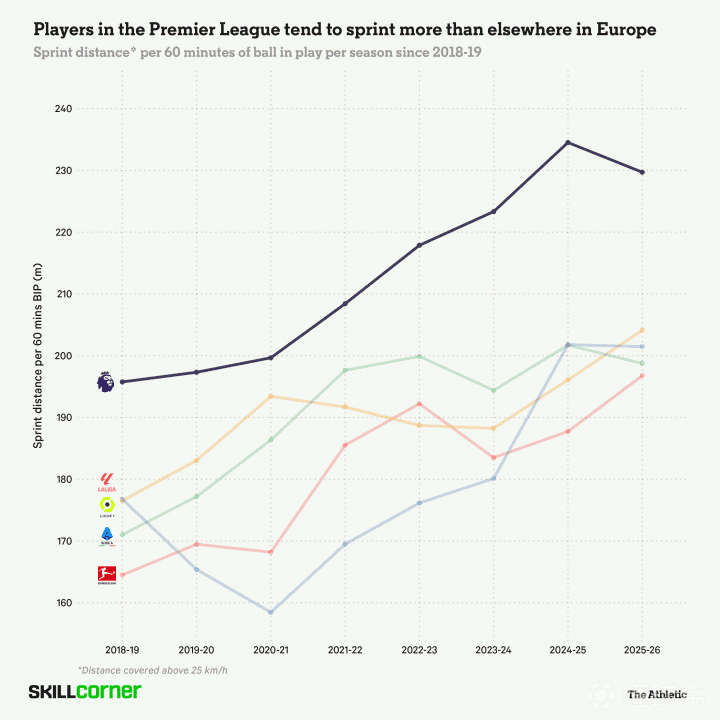
None of these changes indicate that English football is shifting towards a possession-based style of play.
This is somewhat unusual because: 1) In recent years, approximately 70% of Premier League players are not English; 2) In the 2025-26 season, only one of the 20 clubs will be managed by an English coach for the entire season. English football clearly has deep roots.
At the same time, England fans have almost habitually assumed that this generation of players is technically superior to their predecessors. Now, this view should probably hold true.
For example, three years ago, it was widely expected that England would bring a large number of attacking talents to the 2026 World Cup, including Foden, Palmer, Alexander-Arnold, Grealish—don't forget he was briefly considered England's golden boy—and Mount. Although the latter has been plagued by injuries recently, in 2021, he assisted the winning goal in the Champions League final under Tuchel, and then started in the European Championship final less than two months later.
Of course, you can certainly offer reasons why some of these players should have been in Tuchel's World Cup squad. But their performances for England have been noticeably inferior to their previous major tournament form. Each has their own objective reasons—Mount's injury, Arnold's move to Spain last summer—but it's worth reflecting on why so many technically gifted players have lost their form. The truth is, this generation of players hasn't been as good as everyone expected.
Furthermore, England still lacks a truly reliable and experienced central playmaker. Two years ago, when they reached the European Championship final, they couldn't figure out who to pair with Rice until the very end, and their performance throughout the tournament was chaotic and disjointed. Manager Gareth Southgate tried both Trent Alexander-Arnold and Gallagher at full-back before finally choosing the young Manuel Menou, who had only played half a season as a regular starter for Manchester United's first team at the time.
Elliott Anderson's rise is a huge boon for his successor, Thomas Tuchel, who recently joined Manchester City and is a natural partner for Declan Rice in this tournament. But Anderson's best moments are when he can make significant forward runs and reach the edge of the opponent's penalty area, much like Rice's style of play.
Anderson has adapted well to a deeper role, and this may be his long-term development path. However, he is not the natural fit for a deep-lying midfield partner in front of Rice, a point already demonstrated in England's 2-1 victory over the Democratic Republic of Congo in the round of 32: during the team's comeback from conceding the first goal, he switched back and forth between the deep-lying number 6 and the central midfielder number 8 position. In the semi-final against Argentina, Anderson played further forward, while Rice dropped slightly further back, the exact opposite of the previous arrangement.
English football continues to produce versatile midfielders who cover a wide area.
Players like Alex Scott, who excel under high-pressing systems, or James Garner, who was occasionally deployed as a full-back by Everton last season, possess technical talent and fit this style of play. This is probably the only way a modern Premier League midfield can succeed, but England needs more if they want to go further in major tournaments.
Some might mention Menou – despite his talent, he seems to be going through almost his fourth phase of inconsistency between club and country – or Crystal Palace's Adam Walton. It's important to remember that both players are only 21 and 22 years old respectively, and, at least at this stage, their positional awareness isn't particularly convincing when they don't have the ball.
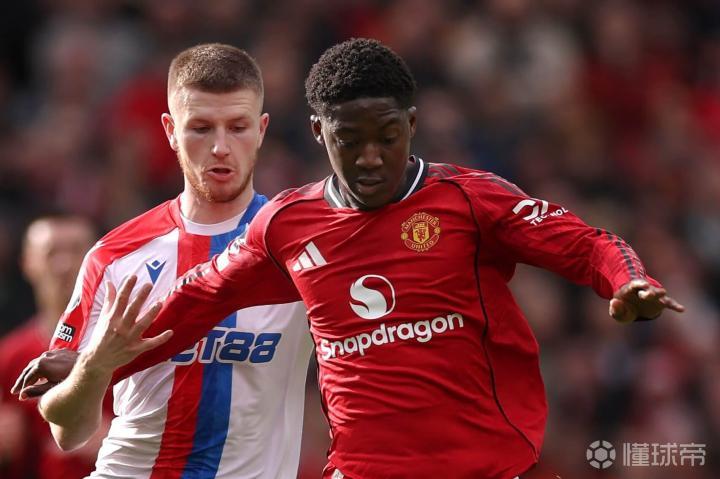
Deep midfielders often reach their peak very late because they need to read the game thoroughly.
Especially Walton, whose image is somewhat misunderstood. He likes to attempt difficult passes, which often leads to loss of possession. This isn't inherently a problem, but his passing accuracy last season was only 79%, about 3 percentage points lower than the Premier League average. Therefore, believing that Walton will be England's solution for stable possession is somewhat unrealistic.
Ultimately, Tuchel's statement about "DNA" is not wrong.
You could argue that he failed to change this DNA; however, it's questionable how much influence a national team manager can have on such a deeply ingrained style of play in such a short time. You could also argue that even if he was telling the truth, he shouldn't have said it that way. Managing the England team is more than just a tactical challenge; it's a public relations job. Tuchel has always been too frank, almost getting into trouble several times.
This is neither criticism nor dereliction of duty. It is simply a reasonable analysis.
Unlike the previous two foreign England managers – Eriksson and Capello – Tuchel had already worked in England before taking over and liked the football culture and style of play here.
In his World Cup squad, Bellingham made free runs behind Harry Kane, there were speedy wingers on the flanks, and two number 8s were positioned in midfield, all of which showcased the best aspects of English football in attack.
His several unexpected defensive choices, with Dan Byrne and Spence both briefly becoming fan favorites thanks to their crucial defensive contributions, demonstrate Tuchel's appreciation for talented players. He also clearly admires Morgan Rodgers and even risked bringing in Stones when he was healthy, so it's not fair to say he doesn't know how to appreciate talented players.
Tuchel has actually embraced English football in a more technical way and led England to the World Cup semi-finals.
Perhaps by Euro 2028, one or more of Scott, Menu, and Walton will have matured into top-class midfielders, or Palmer, Foden, and Alexander-Arnold will have rediscovered their best form, and England will be better at controlling the ball.
Regardless, England, after enduring two tough knockout matches in the high-altitude Mexico City and the sweltering heat of Miami, were worn down by Argentina and exhausted. Perhaps their DNA is better suited to playing on home soil in the European Championship.