What Inspirations Has the World Cup Brought to Chinese Football? (Sports Observation) By Chen Chenxi, Kong Qingyuan, and Wang Liang, People's Daily (July 28, 2026, Page 17)

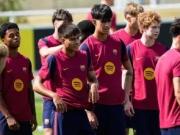
On July 25th, the Suzhou team and Wuxi team of the 2026 Jiangsu Provincial City Football League (hereinafter referred to as "Suzhou Super League") staged the "Taihu Derby" at the Suzhou Sports Center Stadium in Jiangsu Province, with more than 30,000 fans braving the high temperatures to cheer on the team. At the start of the match, Pedri, a player from the Spanish national team who had just won the 2026 USA FIFA World Cup, took to the stage to support the "Suzhou Super League" players by passing the official World Cup ball, "Triple Wave." This was Pedri's first visit to China, and he was deeply moved by the vibrant football atmosphere and enthusiastic fans.
A local grassroots "derby" and the visit of a World Cup-winning player brought together the fervor for Chinese football with the aftershocks of a top-tier international tournament. What insights has the World Cup offered to Chinese football? Reporters interviewed relevant experts.
Cultivating a rich soil makes playing football a part of life
A key characteristic of this World Cup is that world football is returning to its long-standing patterns. The fact that the world's top four teams ultimately advanced to the World Cup semi-finals demonstrates that the highest level of competition has evolved from "star player competition" to "systematic competition" and "ecological competition."
Wang Zhiyuan, associate professor at the International Football Academy of Tongji University, said: "The fact that the top four teams in the world have entered the semi-finals is not only based on the synergistic combination of passing quality, running efficiency, formation effectiveness, and the key role of star players, but also reflects the combined effect of the stability, bench depth, and tournament experience of top teams."
Looking at the rosters of this World Cup, the 1,248 players belong to 449 professional clubs in 71 countries and regions worldwide. This vast and interconnected network of professional clubs forms the underlying support for the competitiveness of each national team. While traditional powerhouses like Spain, France, and England have distinct tactical styles, they share striking commonalities: comprehensive youth training systems covering all age groups from six to adulthood, stable professional leagues at all levels, and regular youth tournaments. Football is deeply integrated into the daily lives of the people. In France, for example, free community pitches are ubiquitous in cities like Paris and Lyon, allowing many young people to play football on the streets from a young age. Scouts work at the grassroots level to select talent, and stars like Mbappe and Dembele all started their careers on free community pitches near their homes.
Liu Jinsong, a FIFA football management and competition expert and a member of the Chinese Football Association Council, said: "What Chinese football needs to learn is the underlying principles of football development: On the one hand, it should actively integrate into world football and cultivate players, coaches, referees, managers, and professionals in competition organization, marketing, media communication, sports science, and sports medicine; on the other hand, it should establish a competition system that covers participants and clubs of different ages, levels, and types, so that everyone has a chance to compete and there are pathways at every level, allowing the best to stand out."
Compared to football powerhouses in Europe and America, my country's nationwide football atmosphere still has room for improvement. In recent years, the number of registered elite youth football players in my country has increased significantly, exceeding 100,000, but this is still far lower than in many European countries with populations of less than ten million. According to the "2025 Chinese Football Association Digital Annual Report," there will be approximately 126,000 certified football coaches in China in 2025, but the number of elite coaches specializing in early childhood development is extremely small, and grassroots outreach is severely insufficient. Many families link football to school admissions and career prospects, making participation in football training overly utilitarian.
“We should cultivate a football culture starting from the grassroots level. China has more than 1.4 billion people, but the atmosphere where playing football is a part of life is not strong enough. We should let children enjoy football, not just focus on achieving results. We must respect the laws of football development and connect with the world football network and development track as early as possible,” said Wang Zhiyuan. In his view, our youth football training should be more systematic and scientific in talent selection and training, adhere to integrated training, and continuously improve the channels from school leagues, grassroots leagues to professional leagues.
Establish a development system that is "suitable" to local conditions
Competition within football systems is another important signal conveyed by this World Cup. Today, digital technology and the global flow of talent are reshaping the development paths of football in various regions. Simply copying other countries' models will not create long-term competitiveness. Chinese football needs to build a system tailored to its local resources to continuously narrow the gap with the world's top teams.
This World Cup is being hailed by the industry as the first AI (Artificial Intelligence) World Cup, consuming 3% of the global daily AI computing power. The stadiums are equipped with intelligent footballs that collect data 500 times per second, millimeter-level 3D digital human scanning systems, and AI-stabilized cameras for referees. All 48 participating teams can use the AI tactical analysis system free of charge, significantly lowering the barrier to tactical analysis. Wang Yuxiong, director of the Sports Economics Research Center at the Central University of Finance and Economics, said, "The large-scale application of technologies such as artificial intelligence, sensors, and 3D visualization at the 2026 USA-CMC World Cup is profoundly reshaping the sports industry chain, from athlete training and event operation to the spectator experience and the development of intangible assets."
"With the expansion, this World Cup has not only increased the number of participating teams, but also the space for global football development. More countries and regions have seen hope of entering the World Cup, and governments, associations, clubs, businesses and families will continue to invest, thus continuously improving the football ecosystem," said Liu Jinsong. "The World Cup is not only a competition between national teams, but also a competition between football systems. What truly determines competitiveness is not who copies whom, but who establishes a development system that suits their own characteristics."
Compared to the impressive record of 9 out of 10 African teams advancing to the knockout stage, only two of the 9 AFC teams, Japan and Australia, made it out of the group stage, highlighting a significant weakness in the overall development of Asian football. Wang Zhiyuan stated, "The backwardness of Asian football stems to some extent from the weakness of its fundamental science. Not only is the science of sports training for football lagging behind, but the development of football philosophy, sociology, and management is also relatively backward. We still have considerable room for improvement in these areas."
Inspire enthusiasm and improve the supply of local grassroots sports events
On the evening of July 25th, the 2026 Hunan Provincial Football League (hereinafter referred to as "Xiangchao") kicked off in front of nearly 40,000 fans. Xiangchao has undergone a complete upgrade, with improvements in both the scale of the competition and the viewing experience. This season's competition focuses on discovering and nurturing young football talent, providing a platform for promising young players to grow.
In recent years, grassroots football tournaments such as the "Jiangsu Super League," "Hunan Super League," and "Village Super League" have continued to gain popularity, indicating a strong demand from the public for participation and spectating. During the World Cup, several grassroots football tournaments, including the "Jiangsu Super League," were featured on the social media platform Xiaohongshu. These tournaments covered multiple regions in East China, Central China, South China, Southwest China, Northwest China, and North China, generating considerable discussion and reflecting the significant clustering effect that grassroots football has achieved.
Capitalizing on the World Cup's momentum and improving the supply of local grassroots events are key to cultivating a fertile ground for the football industry. As Shui Qingxia, the former head coach of the Chinese women's national football team, said, "Directing the enthusiasm generated by the World Cup to grassroots football can further inspire more people to take to the field and increase the overall participation of society in football."
For a long time, domestic football fans' spending heavily relied on top-tier international events like the World Cup and the top five European leagues to attract viewers. Now, local events combined with local cultural tourism are creating unique appeal, and the domestic football consumption ecosystem is being restructured. The level of domestic football events should be continuously improved; only with the vigorous development of a comprehensive domestic football event system at all levels can long-term, sustainable, and large-scale investment in both hardware and software be sustained.
"Developing football talent, establishing a youth training system, and building a nationwide football culture are long-term projects with no shortcuts. They require not only favorable policies to create a conducive environment but also sustained investment, continuous recruitment of innovative talent, and improved business models. We cannot be satisfied with simply having 'Made in China' products and Chinese brands appear on the international stage; the ultimate goal is to improve the level of Chinese football and build a healthy domestic football consumption ecosystem," said Wang Yuxiong.
The 2026 USA-Mexico World Cup showed us that modern football is about a complete football ecosystem, mature youth training, leagues, and a system of public participation. This provides a reference and lesson for the future of Chinese football. Going forward, we must further address shortcomings in talent development, venue supply, event operation, and commercial development to achieve coordinated development of Chinese football talent, culture, and systems, thereby forging a long-term, stable development path suited to our national conditions.