FIFA president's plan to sell the World Cup has been condemned, and The Telegraph published an article analyzing the factors that could restrain Infantino.
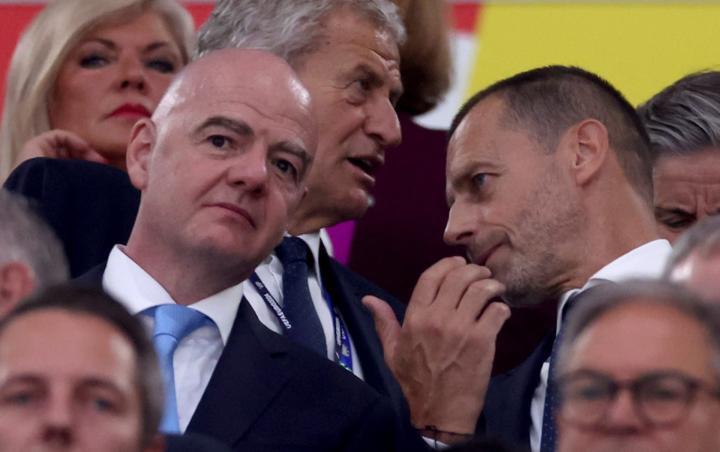
Resistance to Gianni Infantino’s plan to sell his stake in the World Cup is intensifying, with heavyweights in the football world vying to block the FIFA president’s proposal.
Gianni Infantino's growing influence on the world stage is largely due to his close relationship with Donald Trump, but that doesn't mean he's omnipotent.
What would a World Cup without European teams be like? If UEFA's threat to boycott the World Cup ultimately becomes a reality, FIFA will have to seriously consider this issue. Currently, lobbying has begun to determine whether European football can reach an agreement on a joint boycott.
The absence of European teams from both the Men's and Women's World Cups would be devastating for the tournaments. European teams have won five of the last six Men's World Cups; three of the four semi-finalists in this year's World Cup are also from Europe. After all, Spain is currently the reigning world champion in both men's and women's football.
The World Cup is considered the pinnacle of football, and its commercial appeal largely depends on the participation of top players. A boycott by European teams would result in the absence of many of the world's best players, weakening the World Cup on various levels.
The threat of boycotts has been used in the past. In 2021, UEFA President Ceferin warned that European and South American countries would boycott the World Cup if FIFA proceeded with its plan to hold it every two years. A few months later, Infantino abandoned the project, claiming that FIFA had never formally proposed it.
All 55 UEFA member associations must agree to a joint boycott for the action to proceed, so the feasibility of such drastic action remains to be seen. Initial indications suggest that persuading all members to unite on this issue may be difficult. On Wednesday, the Czech Football Association president stated that he "can see the positive impact of FIFA's intentions."
However, each country can still state its position and refuse to participate in FIFA-affiliated events.
Defeated Infantino in the election
The next FIFA presidential election will be held in Rabat, Morocco, on March 18, 2027. Gianni Infantino confirmed his candidacy for re-election in April, stating, "The past 10 years have been a wonderful experience. I am proud to have brought FIFA back to football, and football back to FIFA. This journey will continue!"
As of this writing, Infantino is the only one to have announced his candidacy. He also faced no competition in the 2019 and 2023 elections. Previously, it seemed highly unlikely that anyone would challenge him next year, but the strong reaction to his latest proposal could change that. The deadline for other candidates to register is November 18th, giving potential opponents ample time to organize their campaigns in response to the latest developments.
The problem for any potential challenger is that Infantino appears to have already secured the votes needed to win the election. Earlier this year, the three continental federations of South America, Africa, and Asia all pledged their support for Infantino. These three organizations represent 111 countries, and Infantino only needs 106 votes from FIFA's 211 members to win. Therefore, by this spring, he had effectively secured the victory.
Furthermore, other major footballing nations, including England, also support Infantino's re-election. The Daily Telegraph's sports edition revealed last month that the Football Association (FA) had originally intended to send a letter endorsing Infantino after FIFA requested its members to support his candidacy. Following the Balogun controversy at the World Cup, the FA declined to confirm whether the letter had been sent.
However, these associations may still withdraw their support. The Asian Football Confederation (AFC) said on Wednesday that it was "disappointed" that Gianni Infantino's proposal had not been consulted before being made public. With 47 votes represented by the AFC, withdrawing its support could open the door for another candidate.
Who could challenge Infantino? Paris Saint-Germain president Nasser Al-Khelaifi is considered one of the potential candidates.
As president of the European Club Association (EFC, formerly the European Club Association) and a member of the UEFA Executive Committee, Nasser is deeply involved in football governance. He is also the first Asian to hold a position at UEFA, which may help him gain support in both Asia and Europe.
On Wednesday, the European Club Association, led by Al-Khlefi, issued a statement expressing "serious concern" about FIFA's push forward with its private investment plan and calling for "calm and comprehensive consultations...to establish more rigorous and transparent governance procedures to protect the sport in the long term."
Other reports suggest that Polish player Miłodowski may also be a competitor of Gianni Infantino. Miłodowski is the owner and chairman of Legia Warsaw, and also the vice president of the European Club Association.
CONCACAF President and FIFA Vice President Montagliani has not ruled out running for FIFA president in the future, but is expected to seek re-election in CONCACAF next year.
Infantino and FIFA have indeed garnered some support in Africa. The Confederation of African Football (CAF) has not criticized the plan but has instead asked its members to participate in consultations. The organization will hold a committee meeting next week to "assess and consider the plan."
Increase political pressure
Even before unveiling this latest proposal, Infantino was already facing increasing scrutiny due to his close ties with the Trump administration. For example, earlier this week, a senior Democratic lawmaker wrote to Infantino requesting that he testify before the House Judiciary Committee.
Representative Jamie Raskin, a senior member of the committee, has requested FIFA to provide all records detailing its connections with Trump, the Trump administration, and the Trump Organization.
Raskin warned Infantino and FIFA against destroying or deleting any communications with Trump and his associates, and demanded that they provide "a list of all valuables given to President Trump, his government members, his family, or any entities associated with them, such as the Trump Organization, including transfers, gifts, prizes, awards, or public appearances."
For a long time, Infantino's attempts to curry favor with Trump have been obvious to the world. During the World Cup, the Balogun scandal further fueled criticism of their apparent partnership. Trump claimed he had asked FIFA to review the one-match ban imposed on the US forward, which was subsequently suspended. In response, 72 members of the European Parliament called for an investigation into Infantino's role in the Balogun punishment decision.
Infantino's relationship with the Trump administration will now be under closer scrutiny. The proposed investor consortium will be led by Thrive Capital, run by Joshua Kushner, the brother of Trump's son-in-law Jared Kushner.
Sources downplayed the Trump administration's involvement in the plan, but these family ties will not alleviate the political pressure facing Infantino. British Prime Minister Andy Burnham has criticized the latest proposal, and other politicians and activists have also voiced their opposition to the new plan.
Infantino's opponents hope that the rising political anger will cause the member associations to withdraw their support for him.